Seeing Green: Chemistry Professor Transforming Undergraduate Research at TCU
When it comes to advancing both student success and world-class research, Kayla Green
embodies how the two can go hand in hand. The chemistry professor and assistant dean
of undergraduate affairs at the Louise Dilworth Davis College of Science & Engineering has built an internationally recognized research program while mentoring the next
generation of scientists and reshaping how chemistry is taught at Texas Christian
University.
Her leadership weaves together research and mentorship in ways that have elevated
the department’s impact. With more than $2.5 million in external funding and a track
record of collaboration around the globe, Green’s work has not only advanced the field
of inorganic chemistry, particularly as applied to neurodegenerative diseases and
catalysis, but also strengthened TCU’s standing as a hub for undergraduate research
excellence.
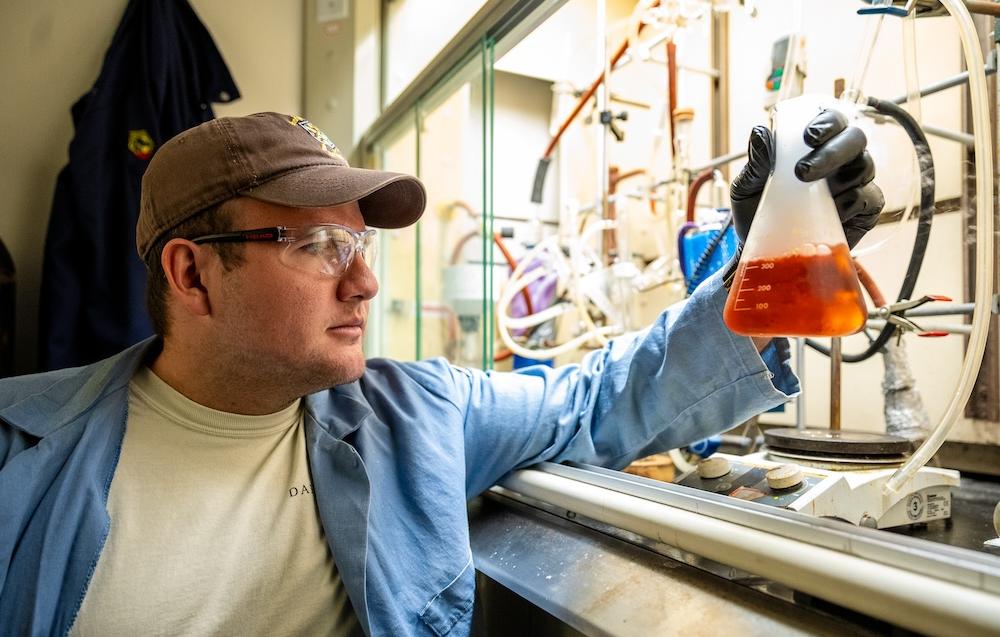
“In the summer heading into my junior year, I began working on what would be my research
project in Dr. Green’s lab … that would use iron as a catalyst in molecules. I would
end up presenting that research in my senior year,” said Jack Bonnell ’24, a John V. Roach Honors College laureate. Iron is more affordable, more available and less societally problematic
than preexisting palladium- or platinum-based molecules.
“By the end of my senior year, I was able to achieve comparable results with my iron
catalyst as you could achieve with palladium or platinum,” said Bonnell, now a second-year
medical student at the Anne Burnett Marion School of Medicine at TCU. “That was a pretty cool moment in my research, to be able to put it up there in
comparison to those.”
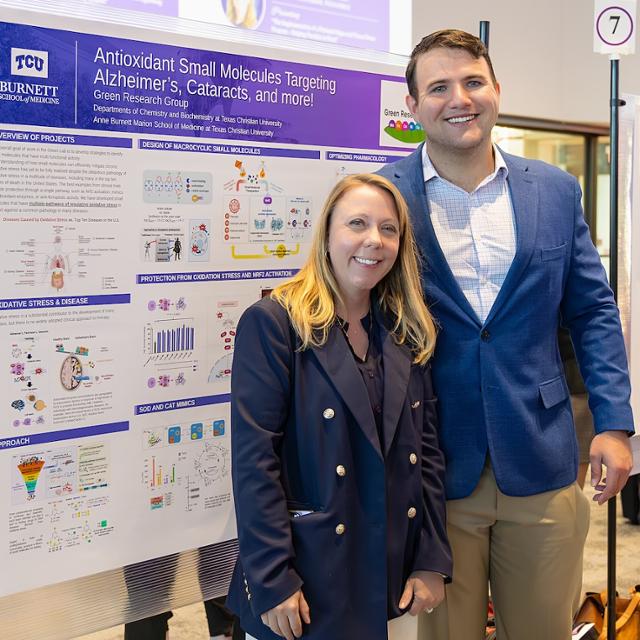
Since joining TCU in 2010, Green has mentored more than 50 undergraduate students
in her lab, many of whom have gone on to publish their work, present at national conferences
and pursue medical or doctoral degrees. She has also been instrumental in creating
programs that prepare students to succeed in challenging classes and stay the course
in scientific disciplines.
“Dr. Green’s vision and drive have strengthened the foundation of our college,” said
T. Dwayne McCay, interim dean of the Davis College of Science & Engineering. “Her
ability to inspire students and colleagues alike reflects the kind of leadership that
propels our mission forward.”
Lifting Them Up
One of Green’s most impactful initiatives is Chemistry Boot Camp, a program she developed
with colleagues Ben Janesko and Heidi Conrad to help incoming students build confidence
before their first chemistry class.
“The boot camp helps lift them up, and it’s really helped with retention of students
in pre-health and science fields,” said Timothy Barth, psychology professor and associate
dean of graduate affairs in Davis College. “She didn’t have to do this; she created
it because of her commitment and dedication to the students.”
Green’s innovative use of grant funding has expanded laboratory resources, supported
student travel to conferences and strengthened research collaborations. The result
is a department that rivals larger institutions in both output and opportunity.
“Davis College does a fantastic job on undergraduate research training,” Green said.
“We are a powerhouse.”
For Green, teaching and research are inseparable. Her classroom and laboratory experiences
are deliberately interconnected, allowing students to see how chemistry concepts play
out in the real world.
“Going into a lot of these complicated diagnoses and being able to break them down
into digestible pieces of information for patients is a skill that I definitely can
see as useful in my future as a physician,” Bonnell said.
As much as the material itself, he credits Green’s mentorship and the opportunities
she provided for his preparation for medical school.
“I had only taken Dr. Green’s general chemistry course in my first semester as a freshman
at TCU. I joined her lab in the spring semester of my freshman year, and I knew only
the bare minimum about chemistry. I was in meetings with graduate students who had
been working on projects for years,” Bonnell said. “At the beginning, she bounced
me around, and I worked with different graduate students to learn all the different
things they were doing to find my best fit.”
That blend of rigor and encouragement has become a hallmark of her approach and a
model for other departments seeking to integrate research more deeply into the undergraduate
experience.
Building on Success
Green’s excellence has earned her wide recognition, including honors from the American
Chemical Society (Emerging Investigator and Women Chemists Rising Star awards), TCU’s
Deans’ Award for Research and Creative Activity and, most recently, the Chancellor’s
Award for Distinguished Achievement as a Creative Teacher and Scholar.
She now brings that same analytical insight and collaborative spirit to her position
as the college’s assistant dean of undergraduate affairs, a role she began this academic
year.
“We’ve already begun to experience her decision-making and analysis as part of the
dean’s team,” Barth said. “In a short period of time, she’s proving to be an amazing
and remarkable administrator.”
Looking ahead, Green continues to build on her success through a National Institutes
of Health R15 AREA grant, which supports undergraduate research and provides students
with opportunities to contribute to federally funded science.
“TCU Chemistry has an incredible record of placing students in medical school, Ph.D.
programs and research labs across the country,” Green said. “It’s rewarding to see
our students thrive in environments that started with their hands-on experiences here.”