
The National Championship Debate: TCU Professor Analyzes a Changing College Football Landscape
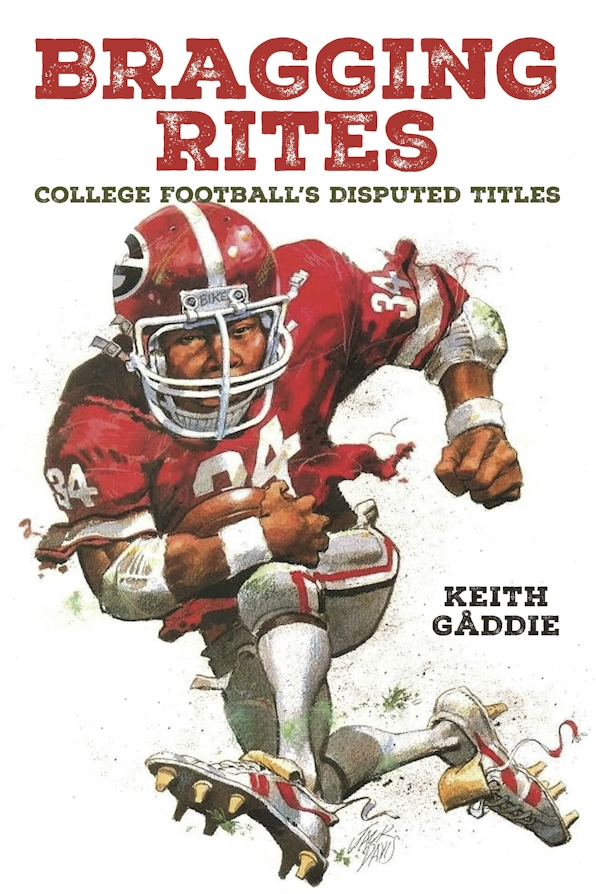
With another high-stakes college football postseason underway and renewed debate surrounding playoff access, conference realignment and the legitimacy of national titles, questions about how champions are determined are once again in the spotlight. Keith Gaddie, Hoffman Chair of the American Ideal, professor of political science in the AddRan College of Liberal Arts and author of Bragging Rites: College Football’s Disputed Titles, studies the long history of contested and claimed championships. In this Q&A, he explains how disputed titles emerged, how today’s postseason structure fits within that history, and what lessons the sport’s past controversies offer for the rapidly evolving landscape of college athletics.

Can you explain what a “disputed national championship” is in college football and
why these disputes occur so frequently across different eras?
A “disputed” national championship is one where more than one group recognized by
the NCAA to confer national titles does so, to different teams, and both teams claim
the title. They happen for a variety of reasons. One is that among the so-called “Consensus Major
Selectors” (AP writers, coaches, Football Writers Association), there is disagreement
over who is best. Another is that aggregator selectors who use algorithms (some of
which have been around for a century) have math that disagrees with the polls or other
aggregators, and someone claims one of their titles. These are also recognized by
the NCAA, and there are roughly 100 of them. Then there’s the “why” — programs want
legitimacy by claiming titles.
How has the evolution of the postseason system in college football (playoffs, expanded
fields, media coverage) changed the meaning of a “national champion” compared to the
eras covered in your book?
The three-stage effort to rationalize who is best has generally made things better.
Initially, it was an informal effort to pair up the top two teams in the AP Poll using
the bowls. This gave way to the BCS system, which formalized the matchup using a formula
made up of polls and math, and which is required to be endorsed by the Coaches Poll.
Then the CFP (playoff) expanded the field to four teams, then eventually 12 (and it’ll
keep growing).
The common thread is that whenever a good team gets left out, journalists, coaches and fans stoke controversy and demand “reform.” The CFP is 11 years old and is on its third version and will be reformed because of perceived favoritism and subjectivity among the committee.
For now, the championship is more legitimate because it is decided on the field. However, it has opened the door to potential bias and has also likely killed the bowl system when taken in conjunction with NIL and player pay and the transfer portal.
As college athletics undergo significant change, from conference shifts to postseason
restructuring, what historical patterns from disputed-title eras provide the most
insight into today’s landscape?
The biggest insight is that there is always a brand-tradition bias (‘pointing to your
logo’) which inherently favors blue bloods, legacy blue bloods and recent dominant
programs. The sport favors its favorite.
What lessons from past disputed titles do you believe are most important for today’s
players, fans and institutions to understand, especially given the current changes?
The press and public demand a singular champion and a process to pick one. But the
fans and journalists also demand matchups and participants that favor their prejudices.
These two things are inherently incompatible. But the biggest single takeaway is that
objective math and subjective expert opinion generally align. But when the journalists
and the math disagree, the journalists can make the argument, being reporters. The
math sits there, being math. It can’t write its argument.