Beyond the Victory: What Remains After the Alamo Bowl Ended
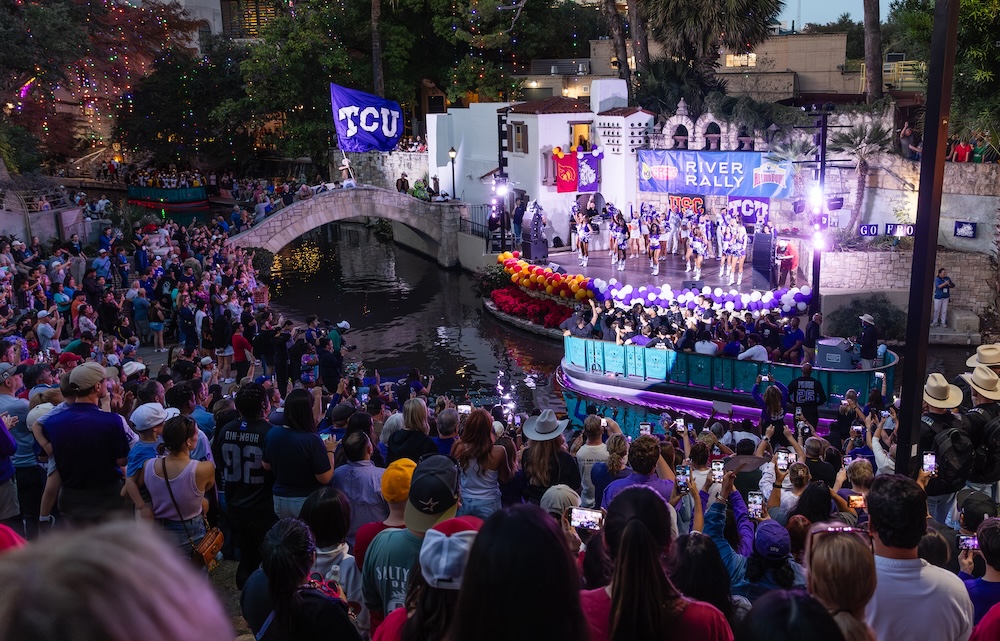
By the time bowl week settled in, purple had washed over San Antonio.
It showed up along the River Walk, near the team hotel and in the way people wearing
the same color seemed to notice one another without trying. A nod. A smile. A casual
“Go Frogs” exchanged in passing with strangers who suddenly felt like friends.
Throughout the week, Horned Frogs moved through the city in small, overlapping waves. Some came from as far away as Australia, while many others took the short drive south
on I-35 from North Texas. All of them came in hopes of another thrilling TCU Alamo
Bowl win.
Inside restaurants and along the river, conversations started easily. Where are you
from? When did you graduate? Were you at the last Alamo Bowl game? Before long, strangers
were trading stories about campus, seasons past and why TCU games — especially in
San Antonio — never fail to create lasting memories.
Anthony Renteria ’91, president of the San Antonio TCU Alumni Chapter, has lived much
of that experience himself — from student to local alumnus.
“I was excited knowing TCU has had two incredible Alamo Bowl appearances in the last
10 years,” Renteria said. “Our Horned Frog resiliency and tenacity have made TCU a
favorite of the San Antonio community.”
San Antonio has long been one of TCU’s strongest alumni markets, and during bowl week
the line between visitors and locals blurred. Tailgates stretched longer than planned.
Alumni events turned into extended reunions. People made plans to meet again before
the week was over.
For current students, the experience offered a firsthand view of what it means to
be a Horned Frog for life — seeing alumni return, reconnect and carry their TCU pride
well beyond campus.
On game day, fans filled the Alamodome with an unmistakable Horned Frog presence as
nearly 55,000 people took their seats for the marquee matchup with the University
of Southern California. The Alamo Bowl drew strong national viewership as TCU delivered
a dramatic postseason finish once again.
What followed felt familiar to anyone who’s watched TCU play in this game before.
The Horned Frogs trailed. They rallied. The game stretched beyond regulation. Again.
A pattern that has defined TCU’s history in the Alamo Bowl: comebacks, overtime and
unforgettable finishes that refuse to be anything other than thrilling.
When the game ended, people didn’t rush for the exits. They lingered. The reaction
felt shared. It wasn’t just head coach Sonny Dykes or quarterback Ken Seals or the
Horned Frog football team who earned all the confetti and balloons. The fans knew
that they had a hand in this victory as well.
“From Chapel Hill to San Antonio, Horned Frogs showed up all season long,” said Chancellor
Daniel W. Pullin. “This team showed resilience and heart when it mattered, and the
support from our fans never wavered. That combination — the way our student-athletes
compete and the way our community stands behind them — is unique and something we’re
deeply proud of.”
Mike Buddie, TCU’s director of intercollegiate athletics, framed the moment in a way
that felt familiar — not because of the outcome, but because of the response around
it.
“The Alamo Bowl's place in TCU Football’s history added another incredible chapter
to close the 2025 season, and our football team could not have rallied back without
the incredible showing by our fans in San Antonio,” Buddie said. “This team’s story
is a testament to their love for each other and for representing TCU, and I believe
everyone watching the game at home or in the Alamodome was able to see that.”
A few days later, San Antonio and its famed River Walk returned to its usual rhythm. The crowds thinned. Bowl week moved on.
But traces of TCU remained — in photos still being shared, messages still being sent and conversations about the storybook win over USC, complete with an unexpected quarterback who ended
his college football career as MVP.
That’s how TCU shows up. Not quietly. Not predictably. Together. And, often, right down to the final
play.