Chancellor’s Student Research Award Celebrates Next-Gen TCU Research
Shannon Matthews was not a researcher when she decided to pursue a master’s degree
in kinesiology at Texas Christian University’s Harris College of Nursing & Health Sciences. She was not even a kinesiologist.
She was a retired high school teacher who saw a big problem: We talk to women about
bone health, but most of our bone density is determined long before those conversations
start.
“How do we close that gap while also helping women where they are now,” Matthews asked.
And so began her foray into research.
“TCU has opened doors in research I did not know existed,” Matthews said. “Research
doesn’t have to feel distant or intimidating. My work is rooted in something simple:
helping women stay strong, mobile and confident throughout their lives.”
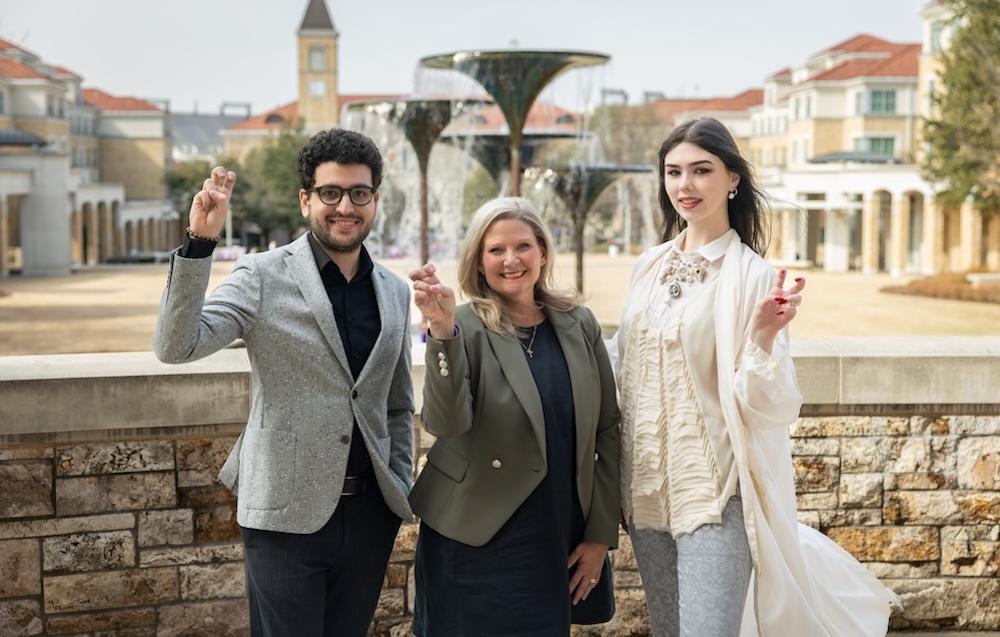
Matthews, along with TCU College of Fine Arts senior Adelaide Lovett and Louise Dilworth Davis College of Science & Engineering doctoral student Ugur Topkiran, were recipients of the Chancellor’s Student Research
Award, created by Chancellor Daniel W. Pullin to support promising student research
at TCU.
“Creating the next generation of researchers is integral to building a research enterprise
and to impacting our global community,” Reuben Burch, vice provost for research, said.
“These students are pursuing important breakthroughs in the fight against Alzheimer’s,
in women’s health and in space exploration.”
More than 150 Horned Frog student researchers presented their work during LEAD ON:
Values in Action Week this academic year, and 10 finalists were chosen and submitted
applications for further funding, with three being selected for the chancellor’s award.
Learn more about the winners and their research:
Adelaide Lovett
Senior
Fashion Merchandising/Psychology
Tell us about your research.
Space suiting requires flexible, low-profile seams that keep lunar regolith, or dust,
out of the inner layers of the suit to prevent damage to machinery and mitigate health
risks for astronauts. The current seams needed to be improved while minimizing bulkiness
to maintain motion capacities. Our hypothesis followed that a seam with more folds
and compaction would lessen the penetration of lunar simulant, thus the invention
of the specially engineered “mutant” seam.
The samples were filled with lunar simulant, weighed, individually spun in a rock
tumbler, photographed both internally and externally, brushed and weighed post-tumbling.
The results showed that thread type played a significant role, as the polyester thread
collected less dust than the nylon. Overall, the results showed that seam design impacts
dust collection, as the “mutant” performed 55% better than the French seam with polyester
thread and 82% better than the flat-felled seam with polyester thread in Kevlar samples.
How will this award allow you to advance your research?
The initial formulation and testing of the “mutant” seam provided significant results
pertaining to the aim of the project, but also illuminated the next steps for testing,
specifically in thread type and tex (weight or thickness), physical characteristics
of the seam, and fabric and interfacing considerations. As thread type had a significant
impact on dust collection, testing different TEX values will be an avenue for understanding
how the thread and seam interact with regolith.
As the flat-felled seam is currently used in suiting and its characteristics are well
documented, the same needs to be done for the “mutant.” Strength, durability, flexibility
and abrasion characteristics are all tests that will be run on the “mutant” seam to
better understand its properties. As the Kevlar samples were backed with fusible interfacing,
future testing will investigate this component to determine the role it plays in the
seam’s interaction with regolith.
This award will allow me to take the next steps with the “mutant” seam while also
opening the seam’s design to variation for comparative analysis. It will allow me,
along with the team, to reach further into discovery and enable travel to conferences
to present our findings and gain vital feedback from industry professionals. With
this award, we will be able to reach wider, building more connections with other students,
faculty advisers and industry professionals to innovate further.
Shannon Matthews
Master’s student
Kinesiology
Tell us about your research.
I study how the physical activity girls and women engage in throughout their lives
affects how strong their bones are as adults. The early teenage years are especially
important because that’s when most bone development happens. My research looks at
whether being active during those early years and staying active over time leads to
better bone health later on.
What’s next for you on your project? What will this award allow you to do?
This award allows me to take the next step in my project by moving beyond simple correlations
and digging into why certain activity patterns matter more than others for women’s
bone health. With this support, I’ll be able to recruit a larger and more diverse
group of participants, strengthen my data collection methods and begin developing
a model that can better predict adult bone density based on lifetime movement.
Most importantly, this funding helps me translate the science into something practical.
My goal is to create clear, accessible recommendations that empower girls and women
to use physical activity — especially strength-based movement — as a tool for lifelong
skeletal health. This award brings me closer to building resources that can shape
education, inform public health messaging and ultimately help women protect their
bone health across their lifespan.
Ugur Topkiran
Ph.D. candidate
Physics
Tell us about your research.
My research is about using very tiny, glowing particles as tools to understand and
improve human health. In my earlier work, I focused on a simple but important question:
How do these tiny particles actually get inside cells? Answering that helps scientists
use them more safely and effectively for things like imaging and future medical applications.
I’m driven by the goal of developing tools that can improve how we detect disease
and deliver treatments with fewer side effects. As my research has grown at TCU, I’ve
started connecting these same tools to neurological and aging-related problems, especially
questions about brain health and what changes might appear early, before disease becomes
severe.
How will this award allow you to advance your research?
This award helps me take the next step by moving from “cells in a dish” to studying
brain health in live animal models. Specifically, I’m working toward a noninvasive
way to see signs of brain vascular changes, like how well the brain’s protective barrier
is working and how blood flow pathways look under aging-related conditions.
That matters because brain vascular problems are increasingly recognized as something
that can show up early in cognitive decline. With the support from the chancellor’s
award, I’ll be able to generate the kind of strong early results needed to prove the
approach works and build momentum toward larger funding and broader impact within
the field.