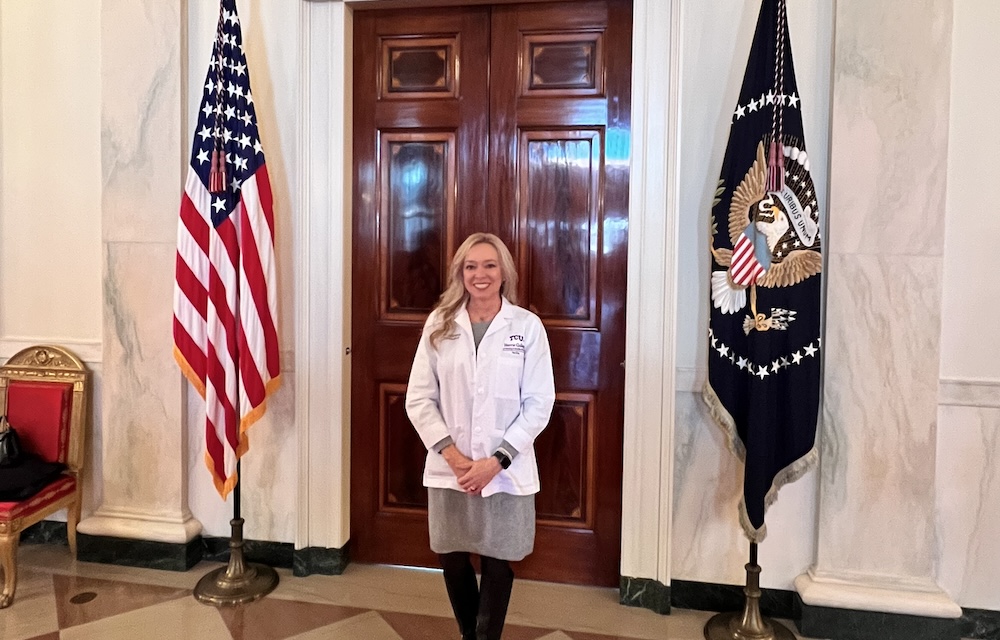
Harris College Faculty Joins White House Panel on Rural Health
Vicki Brooks, associate professor of professional practice and director of graduate nursing, was
recently invited by the White House to represent the rural nurse and rural nurse practitioner
workforce, as well as TCU. The Rural Health Transformation Program (RHTP) is a commitment to sustaining the future of a healthy rural America, recognizing
that real progress requires both system redesign and full use of the health care workforce.
For Brooks, it was not only a professional honor but also a personal issue that hits
close to home.
“I have lived and worked in rural America most of my life,” the Harris College of Nursing & Health Sciences faculty member said. “As a family nurse practitioner, nurse educator and rural health
advocate, I have seen how outdated policies delay care in rural communities. Rural
America is resilient, innovative and deeply rooted in community — yet rural families
continue to experience unacceptable gaps in health care access, quality and outcomes.”
The roundtable discussion, held this month, had about 100 in attendance to examine
prescription drug pricing, innovation and other topics impacting rural health. Speakers
included President Donald Trump; Dr. Mehmet Oz, administrator for the Centers for
Medicare & Medicaid Services; Secretary of Agriculture Brooke Rollins; and several
governors, senators, other legislators and health leaders.
“Dr. Brooks’ participation in the Rural Health Transformation Program demonstrates
the value of TCU’s voice in national conversations about health care innovation,”
Suzy Lockwood, TCU’s associate dean for nursing and nurse anesthesia said. “It affirms
that the work we do in Harris College — educating exceptional clinicians, elevating
rural health scholarship and promoting evidence-based solutions — has resonance far
beyond our campus.”
Funding was awarded to all 50 states with Texas — given its size and population —
receiving one of the largest amounts.
“Rural health solutions must be flexible and community-driven,” Brooks said. “Telehealth,
mobile clinics and integrated care models bring care to people where they live and
work, and RHTP creates rural programs that allow these models to move forward.”
RHTP’s emphasis on innovation is also critical, she said, and another way the program
promotes practical strategies is by optimizing the health care workforce to practice
at the highest level of their education and training. This approach expands access,
strengthens team-based care and improves the wellness of patients who often have limited
options.
“A healthier rural America strengthens the entire nation. When rural communities thrive,
America becomes healthier, stronger and more resilient,” Brooks said. “Investing in
rural health is essential to improving outcomes and to making America healthier for
generations to come.”