Life of a Landman: TCU Students Equipped for Careers in Energy
The workday life of a landman is sure to have its interesting moments. But if you
watch Taylor Sheridan’s Landman TV series, you might get the wrong idea about what makes their job interesting. While
there could be a rare real-life tale of being greeted at the door by a shotgun-wielding,
wary landowner, the day-to-day stories of landmen generally would not make for riveting
television.
But they are making for an interesting, informative and timely class at Texas Christian
University.
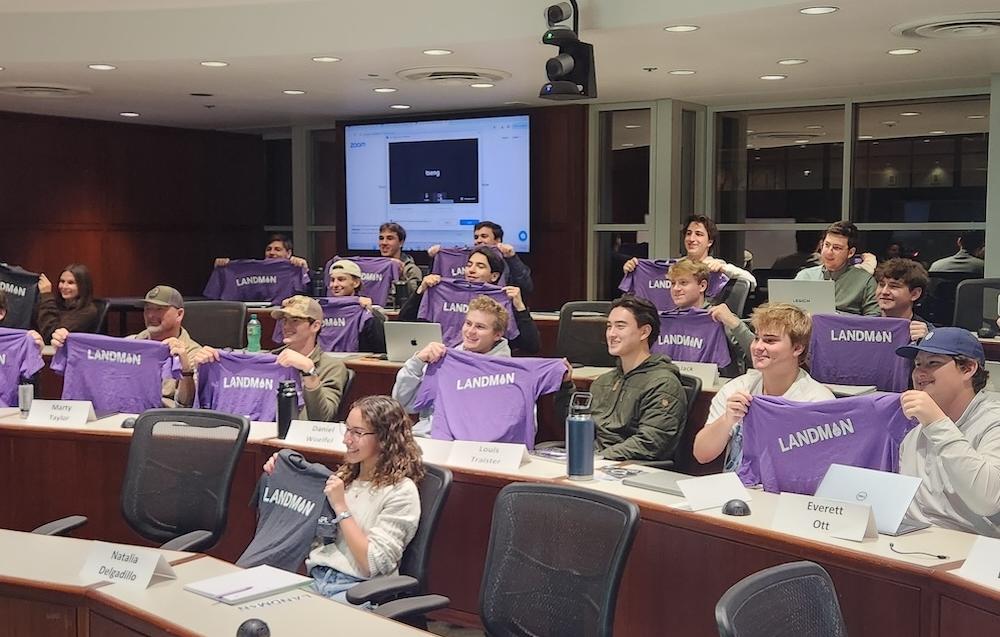
Tom Seng, assistant professor of professional practice in energy finance in the Neeley School of Business, is wrapping up an eight-week seminar course leading students through the ins and
outs of the landman profession. Special Problems in Business: Land Management and
Administration highlights topics such as oil and gas leases, property law and, simply,
“What is a landman?” The class includes Certified Professional Landmen — both men
and women — as guest speakers.
“This class covers many aspects of law, including real property, contracts and mineral
rights. It has broadened my understanding of oil and gas law,” junior Andrew Gentile
said. “The class may present a potential career path. Exposure to these concepts will
help me explore a profession that could be highly fulfilling.”
The political science major and energy business minor has taken previous courses with
Seng, and when he found out about the landman class, Gentile was eager to add it to
his schedule as another step to prepare him for pursuing law school.
While the class is a counterpoint to the Landman television series, partially filmed on TCU’s campus, the course has been on Seng’s
mind for some time.
“The idea for the class had been in the back of my mind when exploration and production
companies in the Fort Worth area would ask me if we had students who were qualified
to be summer land interns,” Seng said. “When the series came out and I saw how outlandish
the portrayal was, I thought the students might want to know what the real profession
was all about.”
Seng, a faculty member in TCU’s Ralph Lowe Energy Institute, previously oversaw undergraduate and graduate programs that are accredited by the
American Association of Professional Landmen (AAPL), which is headquartered in Fort
Worth. The current Energy MBA at TCU is one such program.
Opportunity in the Energy Industry
As the land management course concludes, the hope is that students will come away
with a grounded, authentic knowledge of the profession and an understanding that there
is tremendous opportunity for them in the energy industry.
“The skills landmen develop — negotiation, critical thinking, communication and relationship
management — are highly transferable and applicable across all energy sectors, including
traditional oil and gas, minerals, renewables, solar, wind, data centers and even
bitcoin mining projects,” said Le’Ann P. Callihan ’90, executive vice president and
chief operating officer of AAPL. “This profession offers a dynamic, impactful career
path for those who are willing to learn and adapt.”
Callihan, who earned her degree in strategic communication through TCU’s Bob Schieffer College of Communication, believes Taylor Sheridan got a lot right with his lead landman character, Tommy
Norris.
“He truly hit the nail on the head by portraying the landman as the hero of the story,
and Billy Bob Thornton plays that role to perfection,” she said. “Landmen are problem-solvers,
keen negotiators and relationship architects — and that combination of grit, intelligence
and interpersonal skill is exactly what you see on screen.”
Fiction vs. Reality
Gentile is glad to learn more about how Sheridan has dramatized the profession.
“The challenges Tommy Norris faces are pretty authentic. Being on call and juggling
multiple responsibilities are accurate aspects of the profession. The show illustrates
daily uncertainties well,” Gentile said. “However, cartel involvement and other external
threats are unrealistic. These situations would present serious ethical issues for
AAPL.”
Callihan points to the reality.
“Real land work often involves more patience, documentation and long-term relationship-building
than what can be shown in an hourlong episode. That’s where organizations like the
American Association of Professional Landmen come in,” Callihan said. “We bring the
facts, professional standards and ethics, and real-world education behind the profession
and encourage anyone interested in land work to become a member and learn what the
career truly entails.”
Seng knows there are important distinctions for students to understand the career
of a landman.
“First and foremost, we want students to understand the uniqueness of the private
ownership of oil and gas minerals in the U.S. Thus, there is a need for someone to
go out and negotiate a lease to drill and produce those minerals. Secondly, this is
a richly rewarding profession that employs thousands and heretofore was not widely
known about. Thirdly, they will learn about the legal aspects of land, both surface
and below ground. And last but not least, they will understand that the portrayal
of a landman in the series has been a lot more Hollywood than fact.”
There is also the plain fact, Seng said, that “if the series were called anything
else, like ‘Oil Man,’ this class would not have drawn the same interest.”
The combination of the show’s popularity and the energy of the landman business has
undoubtedly spurred interest. Before the class, Gentile said, a career as a landman
was never a consideration.
“It seemed too niche compared to other jobs in my area. After spending some time in
class, it became clear that landmen can also be attorneys,” he said. “This means I
have the flexibility to pursue a career I did not know about when I started at TCU
as a first-year undergraduate. Thanks to Professor Seng and the AAPL, it is now possible.”