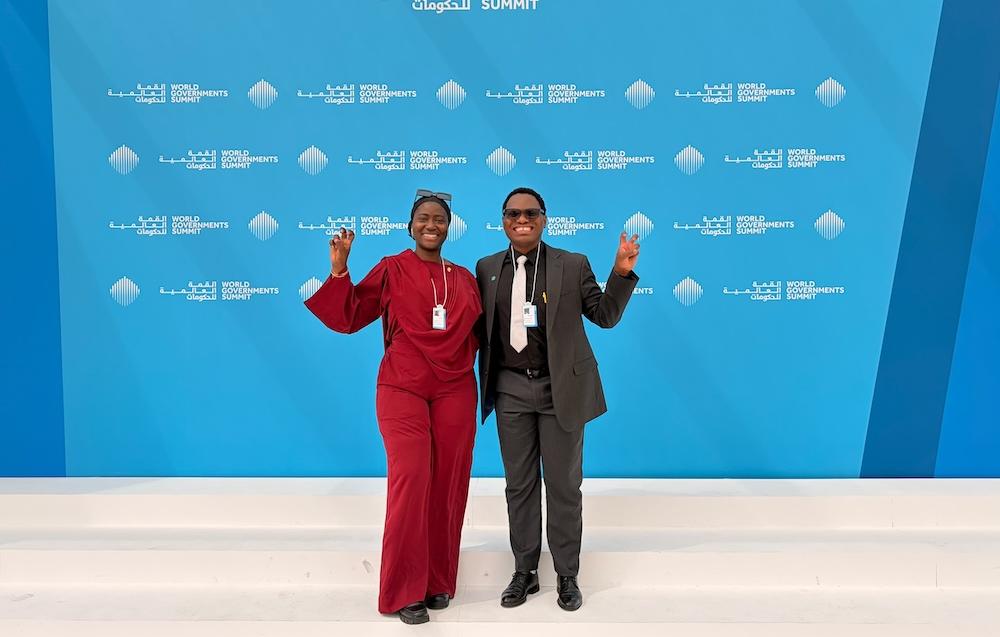
Serving All Corners of the World: Students Claim Global Prize for AI Innovation
Happy Niyorurema and Diarra Niang understand firsthand what it means to learn without
reliable internet access. Long before arriving at Texas Christian University, the
international students experienced an education shaped by limited connectivity.
Niyorurema, a sophomore double-majoring in economics and finance, was raised in Rwanda.
Niang, a junior double-majoring in economics and business information systems, was
raised in Senegal.
Now, the students are transforming those experiences into a globally recognized innovation.
Niyorurema and Niang are the co-founders of Bakame AI, an artificial intelligence-powered education
system that operates without internet access. Their student-led venture recently earned
international recognition, winning the Global Best M-Gov Award in Dubai.
For the two — both students in the Neeley School of Business and the AddRan College of Liberal Arts, as well as in the John V. Roach Honors College — the recognition is meaningful. But it’s also deeply personal.
“We have the experience of living in those communities where internet is nonexistent,”
Niang said. “Our research, but also our experience, revealed that a lot of traditional
educational technology solutions assume people have internet.”
In many regions, connectivity is not only unavailable, it is financially out of reach.
“I come from a place where 1GB of internet is more than 3.5% of the average household
income,” Niang explained. “You have 2.9 billion people across the Global South who
don’t have access to the internet, not because it doesn’t exist where they are, but
because it’s extremely expensive. It becomes a luxury.”
Bakame AI was built to address that gap.
Rather than relying on broadband infrastructure, the system operates through basic
telephone networks. Users can call a phone number and directly interact with an AI-powered
learning assistant capable of delivering lessons, teaching concepts and tracking progress.
“You have a phone number, you call it, and you’re able to have spaced repetition.
You’re able to learn English with this AI,” Niang said. “You can come back the next
day, it’s going to remember you. It’s going to pick up where you left off.”
The platform’s simplicity is intentional. By removing the need for internet access,
Bakame AI opens learning opportunities to users who might otherwise be excluded from
digital platforms.
“There are overcrowded classrooms where we’re from,” Niyorurema said. “In rural areas,
one teacher can have a classroom of 60 students. They don’t necessarily have time
to customize learning for every student. Bakame helps with that.”
Shaping Broader Societal Outcomes
While language learning is one of the platform’s primary uses, the students said it
has much broader applications as well.
“Bakame can also be an information tool,” Niang said. “That last-mile education is
so important because people don’t necessarily know how to treat water, combat some
diseases or know how to have access to some public services.”
Bakame AI’s development was based on the belief that access to learning can shape
broader societal outcomes.
“The average amount of time spent on the internet for many students where we’re from
is eight hours — not per day, per year,” Niyorurema said. “That’s significant because
we’re working under the assumption that when you give kids more opportunities to speak
English, they will not just speak English.
“They will read, they will write, they will explore the world from a different lens,”
he continued. “Part of building strong economies is being able to communicate effectively.”
Growing an Idea
TCU played an early role in making Bakame AI possible.
Through TCU’s CREATE program, Niyorurema and Niang received $8,000 in initial funding
that helped them move Bakame AI from concept to execution. Beyond financial backing,
the students also received mentorship and encouragement across campus.
“I think TCU is genuinely one of the most supportive and uplifting communities I’ve
ever been part of,” Niang said. “Being an international student is not easy at all.
Orientation was my first time in the United States, so I was figuring out America
while figuring out college.”
But, she said, every single person here is working toward your success.
“In the context of Bakame, so many offices and mentors have supported us,” Niang said.
“People have been incredibly helpful in giving us the tools we need to build this
business.”
For Niyorurema and Niang this is a reflection of lived experience, academic growth
and a shared commitment to expanding access.
“Outside the TCU bubble, there are so many communities that could be impacted by what
Horned Frogs build,” Niang said. “We’re really grateful for that support.”
As Bakame AI continues to expand, Niyorurema said the platform remains a work in progress,
being shaped by real-world use.
“We continue receiving feedback in terms of structure and style, both from Rwanda
when we stress-tested the application, but also from our team,” he said.
That feedback, he explained, directly informs how Bakame AI evolves, from technical
adjustments to how it communicates with users.
“We’re going to keep training it and fine-tuning it to truly speak the user’s language,”
Niyorurema said. “That’s critical for making the experience feel natural and accessible.”
The process is far from perfect, but deeply promising.
“It’s like flying the plane while we’re still fixing it,” he said. “A lot of things
are not yet perfect, but we’re incredibly encouraged by what Bakame makes possible.”
Both students’ vision goes beyond any single product or award.
“It cannot be truly general artificial intelligence if it’s not generally accessible,”
Niyorurema said. “That’s the underlying principle behind Bakame. We learn as we build,
and we build to make sure more people can actually benefit from this technology.”