TCU Alumnus’ Nonprofit Creates Pathways for Interdisciplinary Research
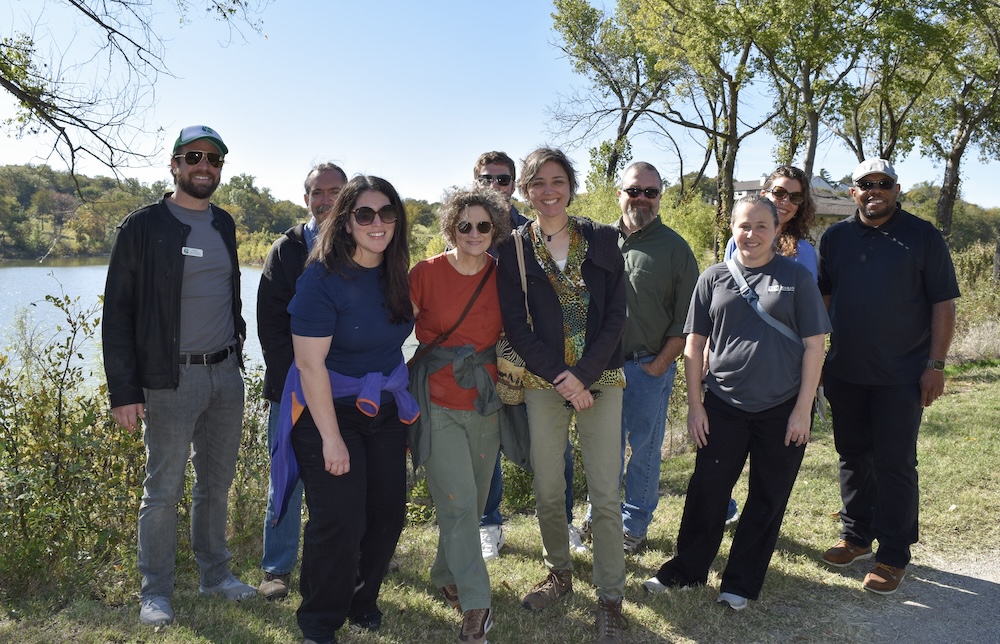
Standing on what was once the 18th tee box of Woodhaven Country Club, a research group
of TCU faculty looked out over a sweeping stretch of land — part meadow, part forest,
part abandoned golf infrastructure. Soon, this landscape will begin a major transformation
as Econautics, a nonprofit founded by attorney John D. Wood ’08, which will convert
the former course into a community-centered hub for regenerative agriculture, youth
programming and sustainability education.
Wood credits much of his early interest in sustainability and community development
to his time at TCU, where he studied English and philosophy. He often says the liberal
arts taught him to look at complex problems from multiple angles, a skill that now
guides the interdisciplinary vision behind Econautics.
“A single project like this touches environmental systems, public health, food access,
policy and culture,” Wood said. “That’s exactly where liberal arts scholarship thrives.”
The research site visit, coordinated through the Interdisciplinary Research and Creative Activity Clusters in the AddRan College of Liberal Arts, brought together faculty from environmental science, nutrition, geography, anthropology,
sociology and English. The goal: to explore collaborations that blend liberal arts
inquiry with hands-on research, community impact and experiential learning.
Dean Sonja Watson established the Interdisciplinary Research and Creative Activity
Clusters to exemplify AddRan’s mission and showcase the “liberal arts in action.”
“The goal of the interdisciplinary research clusters is to bring together teacher-scholars
from different academic disciplines to work collaboratively to address complex problems
that cannot be effectively solved within the boundaries of a single field,” Watson
said. “I desired to cultivate cross-disciplinary collaboration, innovative thinking
and creative work across data analytics; health humanities and society; artificial
intelligence; and community-based research among scholars in the humanities, social
sciences and across the institution.”
Brad Lucas, associate dean of research and graduate studies, emphasized the project’s
potential, describing it as a “living laboratory” where students could conduct research,
engage with community partners and connect their academic training to real-world challenges.
“It’s great that one of our alums is leading this initiative, and the site will allow
a range of academic, professional and practical experiences here in Fort Worth,” Lucas
said. “Experiential learning is key to the future of higher education, and Econautics
is building an outdoor classroom with endless potential for inquiry and collaboration.”
During the visit, faculty gathered insight into how their disciplines could meaningfully
intersect with the project.
Environmental scientists saw opportunities for soil analysis, water testing and ecological
restoration studies. Nutrition faculty identified potential for exploring nutrient
density in regeneratively grown foods and developing community education initiatives.
Faculty from social sciences and the humanities noted the layers of environmentalism,
urban planning, history and narrative embedded in the site’s redevelopment.
For Wood, that interdisciplinary approach reflects the core of the Econautics mission.
After years of work in sustainability and environmentalism, he sees the project as
a chance to bring innovative agricultural methods, youth programming and community
support together in one place, while simultaneously creating a platform for university
partnerships.
“We can’t fix every challenge a community faces,” Wood said. “But we can create access
to things that genuinely change lives — safe outdoor space, nutritious food, education
and mentorship. TCU can play a real part in that.”
As the group discussed classes, research projects and long-term collaboration, one
theme repeatedly emerged: the project’s ability to serve as a model for how interdisciplinary
collaboration can address complex, real-world issues.
Faculty noted that their students often ask how their majors connect to community
impact or sustainability work. This partnership offers a tangible answer.
“This is a place where students can gather data, collaborate across fields and see
the direct connection between academic inquiry and community outcomes,” Wood said.
“It’s learning with purpose.”
With next steps already underway, AddRan faculty plan to continue exploring the project’s
research opportunities, community partnerships and curricular connections.
For many on the visit, the collaboration represents more than just a new field site.
It reflects TCU’s commitment to expanding interdisciplinary research, strengthening
community ties and supporting alumni whose work is shaping Fort Worth’s future.