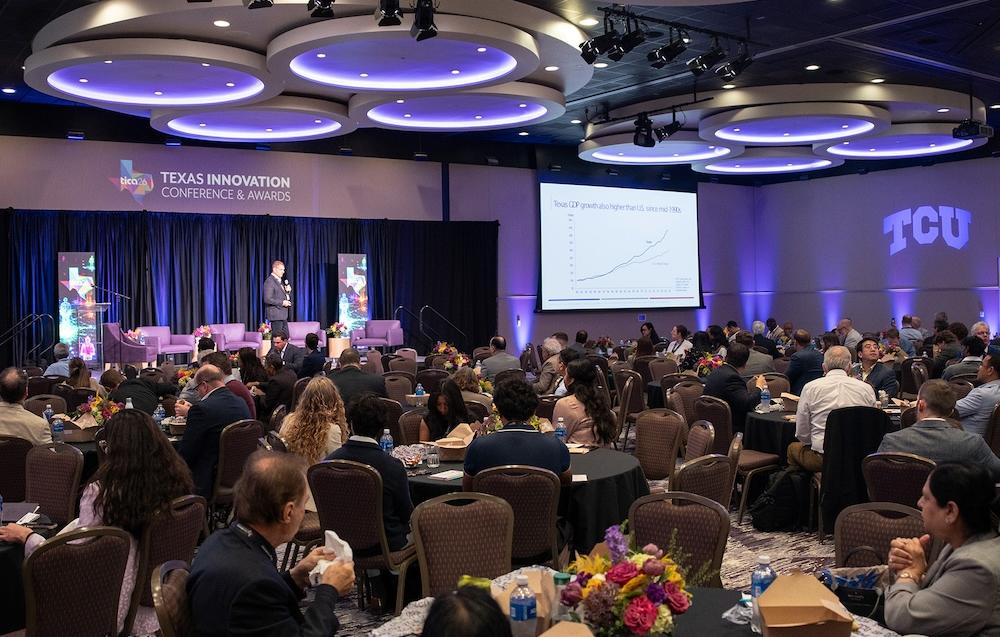
Texas Innovation Conference Highlights Research Funding
Entrepreneurs and researchers have no shortage of ideas. But when it comes to turning those into real-world solutions, funding can feel out of reach. This was the topic of “Where the Opportunities Are: Navigating Federal, State and Capital Pathways in Texas,” a highlight panel of the inaugural Texas Innovation Conference & Awards at TCU April 22-23.
“Universities sit in a unique intersection of federal and state support as well as the pipeline to companies,” said Nathan Cook, senior director, government relations at Rice University. “But you have to control your expectations. Nondiscretionary spending by the federal government consumes 70 cents of every dollar. The rest is where we live.”
Cook was joined by State Senator Royce West and Andrea Coker, chief advocacy officer with the North Texas Commission on the panel discussion moderated by Greg Cox, executive director of Government Relations at TCU.
The conference aimed to highlight people and organizations that are turning research into real-world results by bringing together a select group of high-impact innovators, including startups, researchers and ecosystem leaders.
Navigating Government Funding
Panelists helped illuminate funding options and how they work by providing a practical view of how innovation is funded, including federal programs, state initiatives
and private capital. At the state level, while Texas has money, it’s very protective
of it, said Cox.
“When we see that the state has a surplus, we get really excited,” he said. “But when we visit legislators, they most likely don’t want to make any commitments given the cyclical nature of our state’s budget.” He noted when the legislature is in session – every other year for 140 days – more than 10,000 bills can be introduced but only 20-25 percent pass.
All the panelists underscored that to raise capital, whether from private or government coffers, takes time. It also takes the right approach. As a former staffer, Coker advised attendees to know their audience.
“You will have to speak to staff first, then they’ll feed information to their boss,” Coker said. “Prepare yourself to be able to walk in and explain within five minutes what you’re trying to do and come with a one pager. Find out what they care about and frame accordingly.”
Cox concurred.
“Does this issue move them? Remember, your problem statement when pitching for private capital may not translate to the government sector,” Cox said. “You have to consider is this a problem that they want to solve?”
Find a champion when you can, he recommended.
“Members of the legislature and Congress are real people with careers outside of politics,” Cox said. “If you have an idea, do your research and figure out who understands your world and who can advocate on your behalf.”
An Advocate for Small Business
West, who has served since 1992, is one who is an advocate for small business and
encourages more state-level support.
“Texas is a great state for entrepreneurship and financial investments,” he said. “Business benefits from low taxes, less government and well-educated human capital with 37 four-year universities and 50 public community colleges in the region.”
This combination has helped create what West called the “Texas Miracle.”
“Texas has long been the land of opportunity, but if we want to remain the nation’s leader in innovation and technology, we must ensure that our local entrepreneurs have the tools they need to bridge the gap between a brilliant idea and commercial reality,” said West, who has promoted legislation that focuses on creating such programs to foster job growth.
Building Relationships
Like politics, raising capital is also about building relationships, the panelists
agreed.
“To have credibility and trust, with both agencies and legislature, you’ve got to spend time building relationships,” Cook said.
Coker agreed, advising the audience to network.
“Don’t stay in an insulated bubble. Be in your community, meet people to talk about your ideas, find investors. It’s not self-serving as you need to build an authentic community that will support your business.”
That two-way street is especially important when it comes to encouraging state legislators to help small businesses secure funding through matching federal grants.
“In 1982, Congress established the Small Business Innovation Development Act that funded early-stage technology innovation,” West said. “These federal programs are a vital engine for research and development. In 2022, over 400 Texas businesses secured more than $241 million in federal funding through these grants.”
But the state is leaving potential on the table, he said, noting 22 states match federal funds to help small businesses navigate the rigorous federal application process, but Texas has no such program.
“Think about the dreams we have to further exploration of the moon and Mars,” West said. “A lot of that’s going to happen in Texas. We in state government need to be of assistance to the private sector to make those happen and invest in the next-generation of Texas breakthroughs.”
Awarding Innovators
A centerpiece of the event was the Texas Innovation Awards. These awards recognize
companies and innovators who are driving innovation and economic growth in Texas.
Awardees include SBIR/STTR Phase II award winners and other emerging startups.
The event also featured leading researchers and innovators from every R1 and R2 university in Texas, as well as investors, corporate innovation leaders and important ecosystem partners across the state and region.