Virtual Reality on Wheels: A Mobile Cart Showcases Emerging Tech at TCU
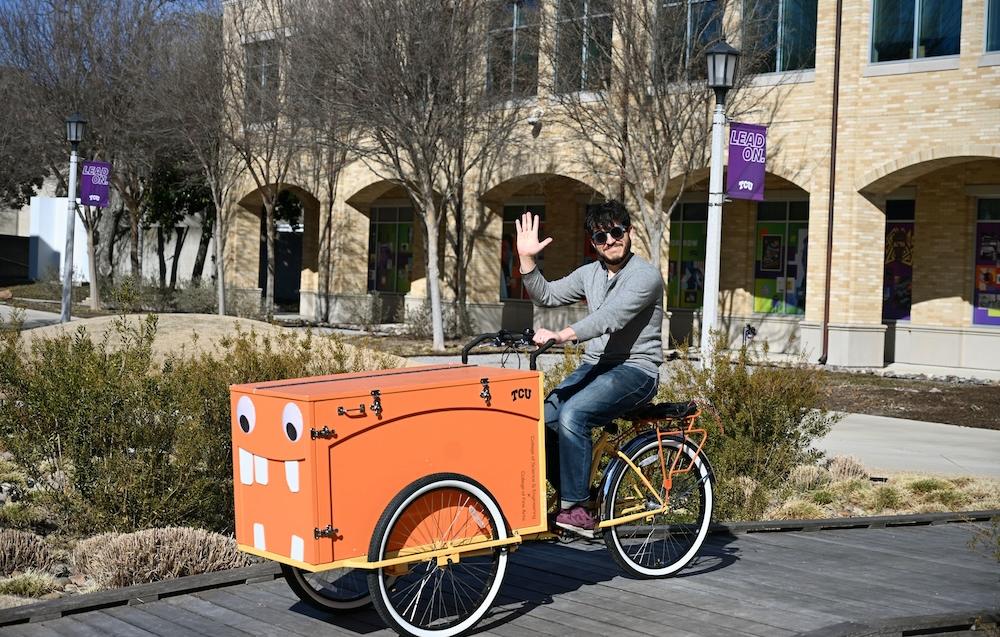
Classroom technology is no longer confined to a room or locked behind a door. Instead, it’s rolling across campus on a virtual reality cart driven by Nick Bontrager, associate professor of art. The collaborative effort between Texas Christian University’s College of Fine Arts and the Louise Dilworth Davis College of Science & Engineering invites students, faculty and staff to engage with emerging technology wherever they may be.
On a campus full of purple, the orange mobile VR cart stands out with its big googly eyes and crooked-tooth smile. It's designed to be ADA-accessible and is equipped with a VR headset, a soundboard and a speaker, combining immersive audio and visual elements. Bontrager wanted to reimagine how students encounter advanced technology, especially with tools that often feel limited to certain majors or specialized spaces.
“My goal is to make it more accessible so that we’re not seeing this emerging technology live in a closet or live in a specific classroom that may go unnoticed,” Bontrager said. “By taking it out of the classroom, the goal is to mobilize some of the newly available technologies for our students, faculty and staff.”
The work has also drawn in students from Davis College, many of whom were interested in the technical side of emerging creative tools. Their collaboration demonstrates how scientific thinking and artistic experimentation can intersect.
Magnus Rittby, emeritus professor of physics, long worked to help students communicate complex ideas beyond traditional academic audiences. In 2015, he launched the SciCom initiative, a program designed to help students share scientific research with the public through creative and interdisciplinary approaches.
“Science and art both involve imagination and creativity,” Rittby said. “Computer graphics, augmented reality and artificial intelligence will not only change business and industry, but also change how scientists will explore our world and how artists will express their creativity. Our students need to be helped to prepare for this new world.”
Innovation Across Disciplines
Bontrager hopes the cart continues to serve as a point of connection across disciplines,
even beyond fine arts and science and engineering. With dozens of majors and minors
represented on campus, he sees virtual reality as a flexible tool.
“We have so many wonderful majors and minors on our campus,” Bontrager said. “I try to find a way for everyone to get a hand on the ball so that, regardless of what they might be interested in making or learning about, they can find an access point.”
The idea is central to how the cart is used. Instead of telling students how to use VR, Bontrager encourages students to think about how the technology might apply to their own interests and future careers.
At the grand opening of the Fort Worth Contemporary Arts Gallery, Bontrager set up the cart outside with images of toys from childhood Christmas catalogs. He cut and pressed them into one-of-a-kind buttons for visitors to take with them. The cart later returned during a Master of Fine Arts candidacy exhibition by student Colby Kohn, where Bontrager used photos of the artists and their work to create custom buttons for guests.
“Professor Bontrager’s presence, along with the mobile art cart, added something personal, generous and memorable to the event,” said Kohn, a second-year MFA candidate in studio art. “It did more than make buttons — it created a small moment of exchange that extended the walls of the exhibition.”
Making Abstract Concepts Tangible
Bontrager has seen the experience spark confidence and excitement in students as they
begin to imagine new possibilities within their own fields of study.
“It gives somebody a little bit of confidence in their own major or minor and an opportunity to share what they’re making or studying,” he said.
Education and virtual reality can work hand in hand by making abstract concepts tangible. Users can experience scale and space in ways they cannot with traditional screens or lectures, Bontrager explained. They can also better understand relationships between objects and spaces they already recognize, bridging the gap between theory and practice.
“Being able to grasp and hold items in a virtual space gives you a sense of human scale, human size, objects and architecture,” Bontrager said.
The mobile VR cart also highlights a larger reality across campus: Much of the technology already available at the university is utilized, but it isn’t center stage.
“We have so many small pockets of technology on our campus that most students, faculty
and staff just aren’t aware of,” Bontrager said. “It’s behind a door somewhere or
in somebody’s office.”
While the cart draws attention to emerging technology innovation at TCU, it also invites
participation. It represents putting tools into the students’ hands. As the cart continues
to move across TCU, it serves as a rolling reminder that technology is most powerful
when it’s accessible and adaptable.