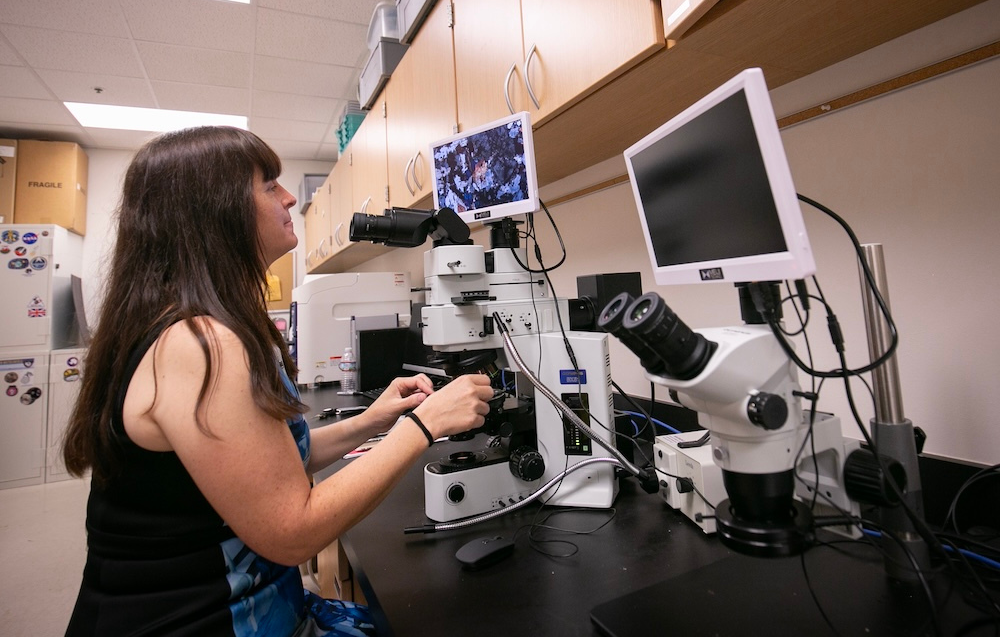
Following NASA Grant, TCU Researcher Explains Planetary Defense
Rhiannon Mayne, Oscar and Juanita Monnig Endowed Chair of Meteoritics and Planetary Science at Texas Christian University, was recently awarded a $3.6 million grant from NASA that will use West Texas’ dark skies and unique geology to help the public learn about asteroids, meteorites and planetary defense. Timed around asteroid Apophis’ close approach to Earth in 2029, the project will create hands-on educational experiences that connect observing meteors in the night sky with the science of meteorites, ancient impact sites and NASA’s work to understand and protect Earth from potentially hazardous asteroids.
Mayne, an associate professor in the Department of Environmental & Geological Sciences in the Louise Dilworth Davis College of Science & Engineering, recently took time to answer some questions about the work and its potential impact.
Why is asteroid Apophis’ close approach in 2029 such a significant opportunity for
public education and engagement?
On April 13, 2029, Apophis will pass closer to Earth than our geostationary satellites.
No asteroid that size has come that close in recorded history and, if the skies are
clear, up to 90% of the world’s population will actually be able to see it without
using a telescope. When it was discovered in 2004, early calculations even gave it
a very small chance of hitting Earth in 2029. That has since been ruled out, which
makes Apophis a great way into planetary defense. The story includes how scientists
found it, tracked it and worked out that it isn’t a threat. The United Nations has
declared 2029 the International Year of Asteroid Awareness and Planetary Defense.
We want people to understand what’s happening and why it matters.
What makes West Texas particularly well suited for teaching people about meteors,
meteorites, impact sites and planetary science?
West Texas puts the whole story in one place. Big Bend has some of the darkest skies
in the continental U.S. The region also preserves impacts at very different scales.
At Odessa Meteor Crater, you can see the crater and hold the actual iron meteorite
that made it. Sierra Madera, near Fort Stockton, was formed by an impact so large
that it destroyed the meteorite, and it’s so well preserved that Apollo astronauts
trained there before going to the Moon. On top of that, the rocks of the region record
about 250 million years of Earth’s history. You can watch a meteor at night and see
evidence of impacts the next morning.
Can you walk us through the Texas meteor-observation network? What will it do, and
how might members of the public interact with or learn from it?
Astronomers rate sky darkness on the Bortle Scale, which runs from 1 to 9. A Class
1 sky is as dark as it gets, with essentially no light pollution. A Class 9 is what
you’d see from the middle of a big city. Dark Skies-Deep Time aims to install three
all-sky cameras along a deliberate gradient, from very dark to very bright. One will
be installed at a remote site south of Sanderson that has some of the darkest skies
in the country (Class 1), and another will be in the town of Sanderson itself (Class
2/3). The third will be at Fort Worth Botanic Gardens (Class 8/9). All three will
stream live, side by side, on a public website, so anyone can see what the sky looks
like at each site at the same moment. That makes light pollution something you can
see instead of an abstract idea. We also want the public to be part of the science.
During major meteor showers like the Perseids and Geminids, the general public can
help us count and classify the meteors observed in each data set, thereby quantifying
the impact of light pollution.
What do you hope someone who participates in one of the educational programs or planetarium
experiences comes away understanding differently about asteroids, meteorites or planetary
defense?
I want people to understand that the meteor they see, the meteorite they hold and
the crater in the landscape are the same process at different stages. Meteorites are
nature’s own sample-return missions. They’re pieces of asteroids, the Moon and Mars
that delivered themselves to Earth.
“Planetary defense” can sound like something out of science fiction. What does planetary
defense actually involve, and what do you want the public to understand about NASA’s
work in this area?
Planetary defense is, at its heart, detecting and tracking near-Earth objects so that
we can mitigate the threat of any that may collide with Earth. You can’t plan a defense
against an object if you don’t know its composition and structure, and that’s where
meteorites and impact geology come in. In 2022, NASA’s DART (Double Asteroid Redirection
Test) mission deliberately crashed a spacecraft into a small asteroid and shortened
its orbit. It sounds like something out of a Hollywood movie or a science fiction
novel, but it’s real. We’ve already shown we can nudge an asteroid off course. I want
people to see that the science they learn about in our program, from meteorites to
craters to orbits, is the same science NASA uses to protect the planet.
The project will also study whether these experiences help people see themselves as
capable of engaging with science. Why is that an important part of the research?
Our program is designed to make people contributors, not just audiences. They submit
real observations and handle real specimens. We will follow participants over several
years to see whether that experience changes how they see themselves in relation to
science. If it does, other museums, parks and planetariums can use what we learn.
This project connects observations of the night sky with meteorites found on Earth
and ancient impact sites. What can bring those pieces together to help people understand
planetary science?
Astronomy and geology are usually taught separately, but they are in many ways part
of one continuous story. We want to connect what people see in the sky with the rocks
beneath their feet. The meteor you watch tonight, the meteorite in a museum case and
the crater in the West Texas landscape are all part of a 4.5-billion-year process
that has shaped every rocky planet. The Moon and Mars are covered in craters. Earth
has been hit just as often, but erosion and plate tectonics have erased most of the
evidence. Learning to read the rock record here is the same skill scientists use to
read other worlds.
What part of this project are you personally most excited to see take shape?
This project has a lot of pieces: a meteor camera network that streams the sky live
from West Texas and the city, hands-on meteorite activities, learning modules built
around the geology and impact sites of West Texas and designing new planetarium shows
for the Monnig’s mobile planetarium. I don’t think I can pick just one part, because
what excites me is how they connect. People will be able to watch a meteor on our
livestream, hold a meteorite, learn about craters and geology using our curriculum
or see it all summarized in a planetarium show. Our hope is that wherever people start,
they’ll come away seeing that the sky and the ground are part of the same story.
By the time Apophis makes its close approach in 2029, what would success look like
for this project?
When Apophis makes its approach, success would mean people across Texas following
along and really understanding what’s happening. Apophis won’t be easy to see from
North America, so we’ll bring in livestreams from observatories in the Eastern Hemisphere
and watch together. Many of those people will have been counting meteors with us for
years by then. Beyond 2029, success means the cameras keep running, and the modules
and planetarium shows are freely available, so museums, parks and planetariums anywhere
can adapt them to their own landscapes and skies.