From Human Voices to AI: Research Empowers Dementia Caregivers
When someone develops Alzheimer’s disease or a related form of dementia, family members often find themselves assuming caregiving responsibilities. As the disease progresses, they're making medical decisions, navigating behavioral changes and managing daily care, usually with little training and even less time to search for answers.
Uma Tauber, professor of psychology in Texas Christian University's Louise Dilworth Davis College of Science & Engineering, believes that empowering caregivers requires more than providing information – it means helping them remember and use it when it matters most.
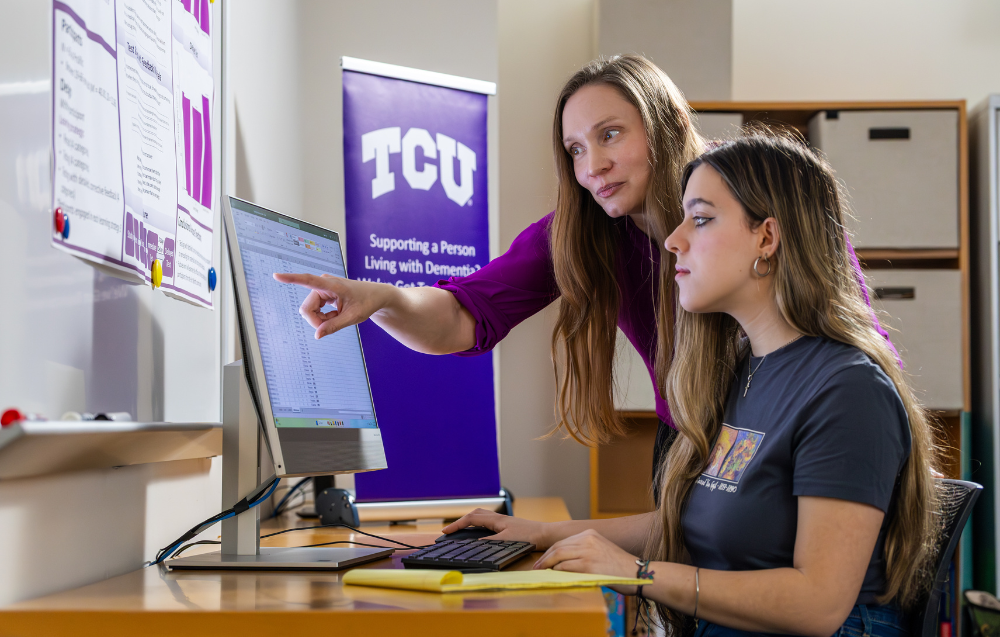
As a cognitive psychologist specializing in learning and memory, Tauber is leading an interdisciplinary research team developing educational tools that help dementia caregivers retain critical information and improve care for their loved ones. The team includes undergraduate and graduate student researchers at TCU, and the work brings together experts across psychology, medicine, nursing, pharmacy and computer science, all working toward the same goal: making caregiving a little less overwhelming.
Applying the Science of Learning
"Caregivers often find themselves in this position unexpectedly," Tauber said. "There are excellent resources available, but when something happens in the moment, they don't necessarily have time to search through websites or educational materials. We want to help them remember the information they'll need when they need it."
Drawing on decades of research in cognitive psychology, Tauber's team uses proven learning strategies, including retrieval practice, spaced repetition and immediate feedback, to create educational interventions that improve long-term memory rather than short-term recall.
Instead of simply reading information once, caregivers repeatedly practice recalling important dementia-related health concepts over time, making them more likely to remember them during real-life caregiving situations.
Building Confidence Through Knowledge
The research aims to change how caregivers understand their experiences.
For example, apathy, a common symptom of dementia, can be confusing and frustrating for families. Learning that the behavior is part of the disease rather than intentional can ease feelings of guilt and frustration.
"It's not changing the symptoms," Tauber said. "It's changing the caregiver's knowledge and perception of them, which helps them feel more confident and better equipped to manage those situations."
That confidence matters. Beyond the physical demands of caregiving, many caregivers struggle with feelings that they aren't doing enough or are making mistakes. Tauber hopes better education can reduce that stress while improving the quality of life for both caregivers and the people they care for.
Research Shaped by Caregivers
One reason the project continues to evolve is that caregivers themselves help shape
it.
Tauber and her students regularly attend caregiver support groups and community events, listening to families describe the challenges they face. Those conversations help determine what educational topics to include and how the materials should be delivered.
"We take a caregiver-centered approach," Tauber said. "With every project, we ask caregivers what they need, what we can do better, and what information would make the biggest difference for them."
The work also provides meaningful research experiences for undergraduate and graduate students, who collaborate with faculty across multiple disciplines and partner institutions.
At TCU, Tauber works alongside psychological science graduate student Ariana Elsden, senior undergraduate researcher Michala Pollard, psychology assistant professor Justin Luningham and computer science professor Robin Chataut.
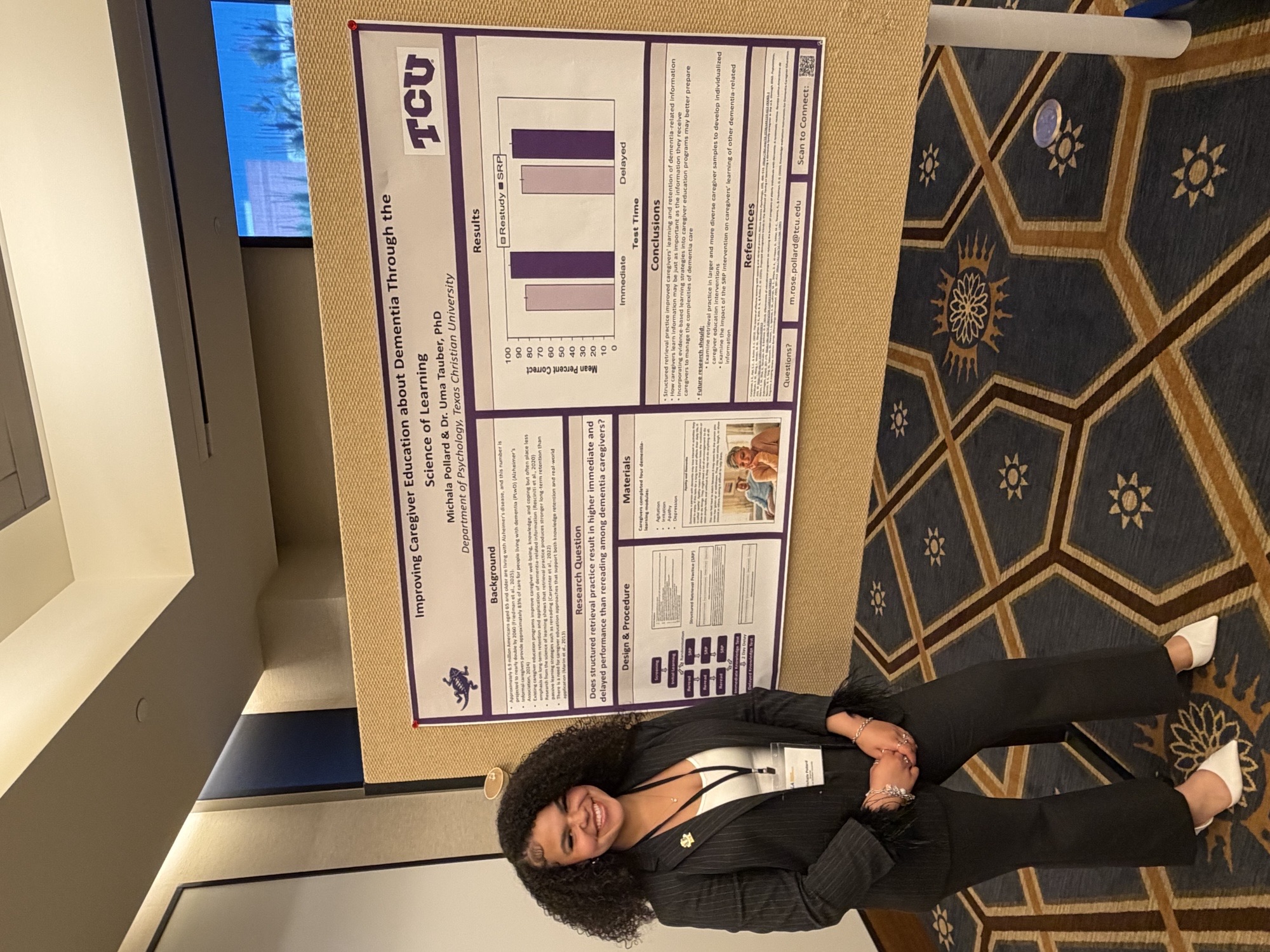
“[Tauber] made me realize that the best way that I could truly help people in the capacity that I wanted to be was through research, specifically translational research that helps implement and change policy,” said Pollard, also a student in TCU’s John V. Roach Honors College. “When I came to TCU, I wanted to help people, and I thought that medicine was the only way. It wasn’t until I met Dr. Tauber and saw the research she was doing that I changed my mind.”
The project also includes collaborators from Batten University (formerly Virginia Wesleyan University), UT Health San Antonio, UNT Health, whose expertise spans educational technology, caregiving science and treatment adherence.
Moving Ahead with Artificial Intelligence
The team's newest project moves beyond traditional educational materials.
Supported by internal funding, Tauber and collaborators in TCU's Department of Computer Science are developing an artificial intelligence tool designed specifically for dementia caregivers. Rather than providing one-size-fits-all information, the system will personalize guidance based on each caregiver's situation, delivering trusted, evidence-based support whenever questions arise.
"I've loved getting to talk to caregivers and being able to be an outlet for them, but also being able to be an opportunity for them to access resources or help,” Pollard said.
The goal is simple: give caregivers reliable answers when they need them most.
For Tauber, the project has always been about more than research.
"We all have the same goal," she said. "We want to help caregivers feel supported, confident and prepared for one of the most challenging roles they'll ever take on."