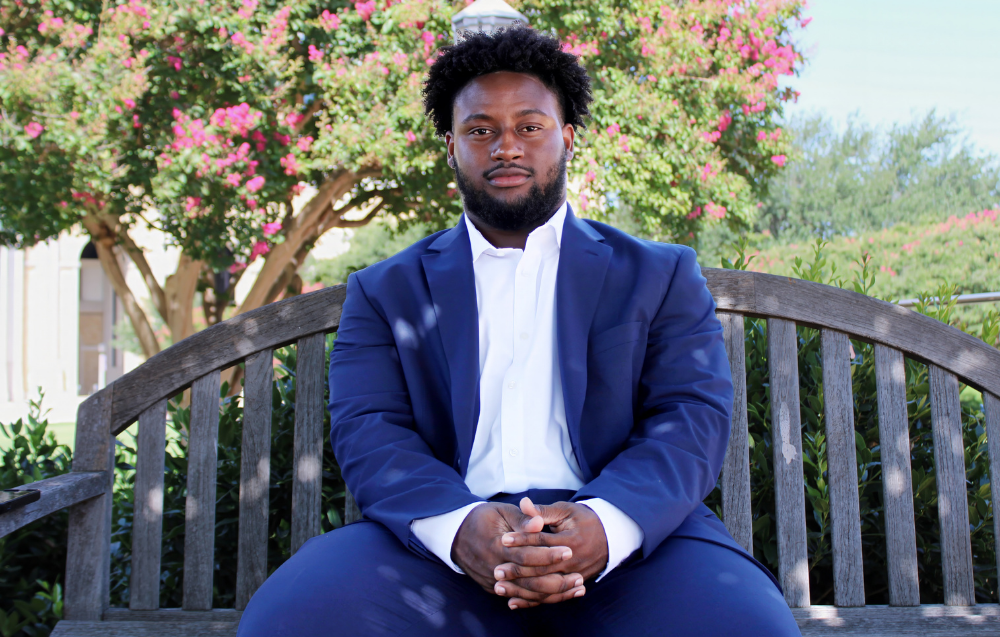
From Student-Athlete to Researcher: TCU Student Studies Life in the NIL Era
When Isaac Shabay’s college football career took an unexpected turn, he didn’t just rethink his future. He turned the experience into research that could help the next generation of student athletes.
Shabay, a sociology major and psychology minor, completed his first independent undergraduate research project through the Ronald E. McNair Summer Research Experience under the mentorship of Amina Zarrugh, associate professor of sociology. His research – titled From Student-Athlete to Athlete-Athlete: Identity, Pressure, and Mental Health in the Modern NIL Era – explores how today’s college football players navigate identity, pressure and mental health in an era shaped by name, image and likeness (NIL).
After transferring to TCU from the University of Pennsylvania, where he played football, Isaac hoped to continue competing. When NCAA roster changes altered those plans, he found himself viewing college athletics from a different perspective.
“Stepping away from football and talking with my friends who were still playing, I started seeing where there was overlap in our experiences,” Shabay said. “I thought, ‘Why wouldn’t I want to study this on a bigger scale?’”
That personal connection became one of the project’s greatest strengths.
“Isaac chose to work on a project that resonated deeply with his own experiences as a student athlete and the numerous forms of institutional and social pressure that accompany that kind of role on campus,” Zarrugh said. “Research that is inspired from our own experiences often enriches the types of questions we can ask and the empathy that we bring to the projects we undertake.”
Drawing from podcasts and public interviews featuring current and former college football players, he examined how the evolving landscape of college athletics is reshaping the student-athlete experience. One finding stood out.
“The most interesting finding to me was finances and relationships, specifically them together,” Shabay said. “Young athletes are receiving significant amounts of money while also trying to navigate relationships with family, friends and teammates. That’s something we need to better understand.”
Transforming an Understanding of Research
Zarrugh said the project arrives at an important moment for collegiate athletics.
“The impact of NIL deals on the student-athlete experience is critically important to understand because it represents a shift in identity from student-athlete to paid employee,” Zarrugh said. “While there has always been pressure on student-athletes to excel in their athletic performances, the stakes of these performances look different in the NIL era.”
The experience also transformed Isaac’s understanding of research. Initially unsure whether he belonged in an undergraduate research program, he discovered that curiosity and lived experience could be powerful tools for asking meaningful questions.
“I’ve never done research before,” Shabay said. “I thought, ‘Am I qualified to do research?’ But taking it one step at a time and having support from Dr. Zarrugh showed me what was possible.”
The project also reinforced his long-term career goal. After graduating in December, Shabay plans to pursue graduate studies in counseling with the goal of opening a private practice for high performers, including athletes. He hopes his research encourages universities and athletic programs to better understand the pressures student athletes face today.
“I think a lot of mistakes come from not being educated,” he said. “The more we understand what athletes are experiencing, the better we can support them. The solution to a lot of problems is conversations.”