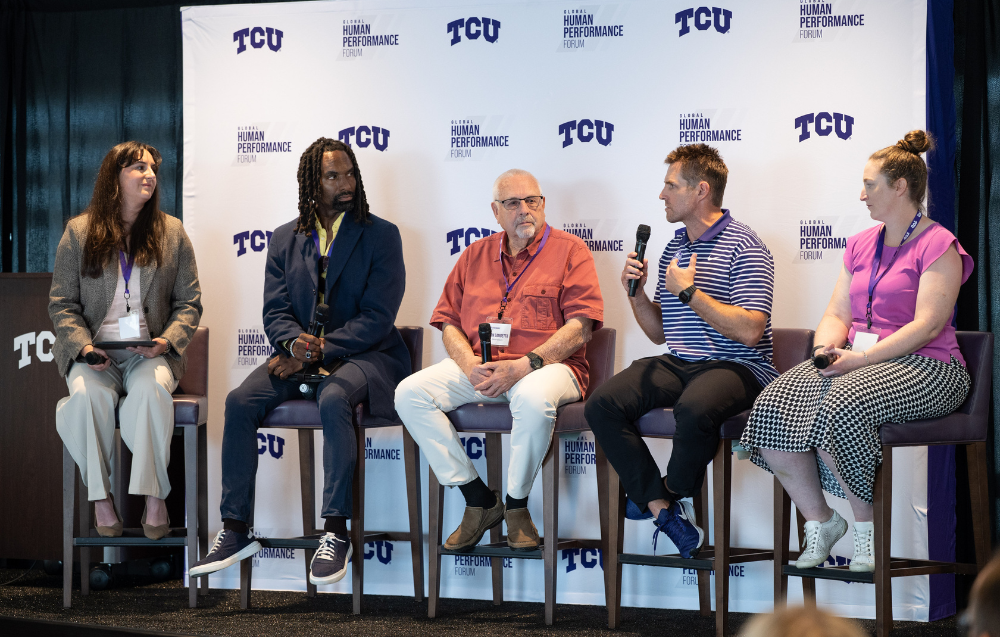
Inaugural Global Human Performance Forum Highlights TCU’s Leadership in Athlete Engineering Research
How did a former SEC fullback and a former New York Yankees pitcher end up at the epicenter of the conversation on human performance? It turns out it’s a very TCU story; one that came into focus at the inaugural Global Human Performance Forum, held recently on the TCU campus.
To understand, you have to go back a bit, like 20 years. Reuben Burch, TCU’s vice provost for research, played for Mississippi State, while Mike Buddie, director of intercollegiate athletics, played for Wake Forest and then the Yankees. Their shared experience competing at the highest levels of sport informs a unique partnership between athletics and research at TCU.
The goal is simple: help Horned Frogs perform at their best and live healthier lives, not only during their four years in Fort Worth, but decades after graduation.
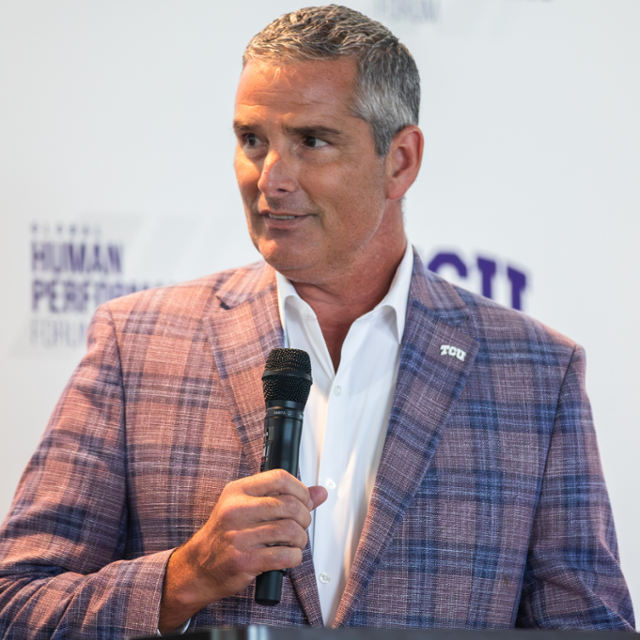
“As the adults in the room, we take that responsibility really seriously to say: Not only are you going to lift weights and do all the things on the field that’ll make you bigger, stronger, faster and therefore able to compete for championships but we are working to make sure that the next 60 years of their lives are really high quality, too,” Buddie said. “It really drives home how important these human-performance, athlete-wellness discussions are. It’s not theoretical.”
Athlete Engineering Far Beyond Sports
Coinciding with the launch of TCU’s Roach Institute of Athlete Engineering, the summer forum brought together global research leaders and TCU faculty and staff
to explore how advances in athletic performance can improve outcomes for tactical
athletes, industrial athletes and others who operate in demanding environments. Research
that helps athletes lift heavier, run faster and recover better has applications far
beyond sports.
The work falls under the emerging discipline of athlete engineering, which Burch developed while at Mississippi State.
Athlete engineering starts with a simple question: How can science help people perform at their highest level while protecting their long-term health? The interdisciplinary field brings together researchers in engineering, medicine, data science, kinesiology and psychology to study human performance in real-world settings. At TCU, that work extends beyond sports to include military personnel, first responders and industrial workers, positioning the university at the forefront of research designed to improve how people train, recover and live.
The research effort is strengthened by global and regional partners, including UT Southwestern and Deakin University in Melbourne, Australia, both of which played prominent roles in the forum.
UT Southwestern is recognized internationally for its medical research. Deakin is home to the No. 1 sport science school in the world and is a member of the Athlete Engineering Consortium alongside TCU and Mississippi State.
“We have a tendency as researchers to get into silos,” said Brad Aisbett, head of Deakin’s School of Exercise and Nutrition Sciences, who offered opening remarks at the forum. “What I know is we have a bigger impact when we collaborate, share research and try to answer bigger questions.”
Translating Research into Practical Application
The forum addressed critical topics such as concussion treatment, managing the explosion
of performance data available to coaches and athletes, avoiding information overload,
and ensuring the human element remains central to human-performance research. The
ultimate goal is to translate research into practical applications on fields and courts,
in locker rooms and training rooms, and in workplaces around the world.
“The forum captured the heart of athlete engineering: better data, better decisions and better outcomes,” said Jim Weinstein, director of the Roach Institute. “TCU is building a place where science and athletics do not sit in separate lanes, but work together to solve real problems for athletes, coaches and communities.”
Science and athletics do not always work hand in hand at universities. As Buddie joked during the forum, at most institutions, the only place he and Burch would be together is under “B” in the campus directory.
TCU is taking a different approach, in part because two of its leaders understand firsthand what could have helped them as collegiate athletes. Working together simply makes sense.
“This is the most connected campus I’ve ever been on. There’s just so much crossover and collaboration that I really think you'd be foolish not to take advantage,” Buddie said. “I’m smart enough to know that I'm not the smartest guy in the room. But I have access to some incredible world-leading experts and, so, for me, I want to embrace that opportunity and take that chance to learn as much as I can from them.”
The Roach Institute
The Roach Institute of Athlete Engineering, made possible by a $10 million gift from
The Roach Foundation of Fort Worth, will serve as a hub for research, collaboration
and community engagement, connecting groundbreaking discoveries to Fort Worth and
beyond.
“I am deeply grateful to the Roach family and The Roach Foundation of Fort Worth for believing in this vision and investing in its future,” Burch said. “It took me one week after arriving at TCU to understand the impact this family has had on the university. I’m honored that athlete engineering is now part of their legacy as well.”
Read more about the announcement of the Roach Institute and learn about how the Harris College of Nursing & Health Sciences played an integral role in the forum.