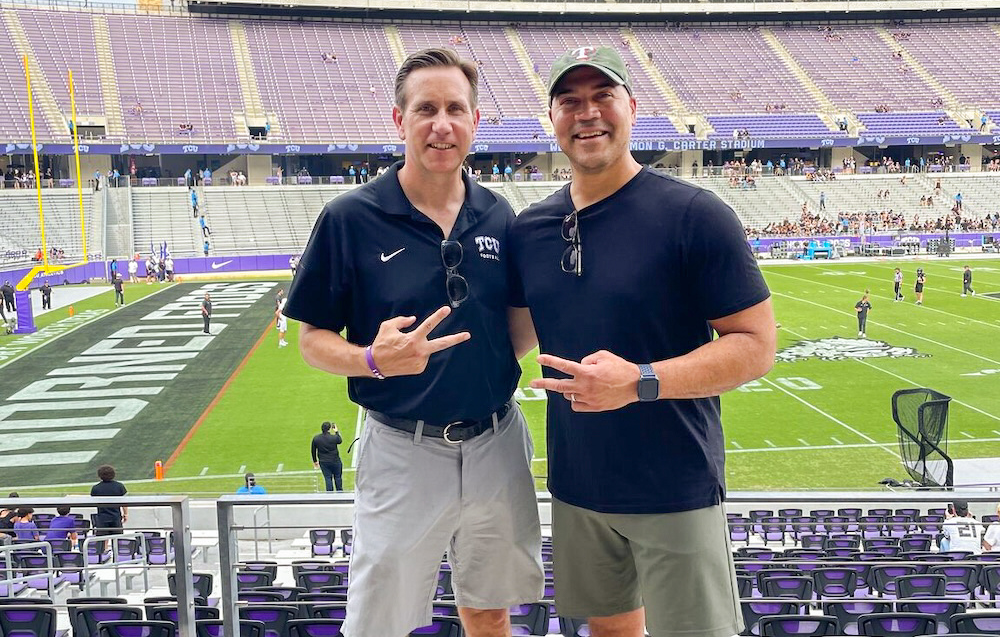
‘Part of our Institutional DNA’: TCU Researchers Stress Importance of Mentorship, Collaboration
Ten years ago, Texas Christian University faculty researcher Emily Lund had a problem — a good problem but still a problem.
The professor in the Davies School of Communication Sciences & Disorders had just earned her first National Institutes of Health grant, but no one in TCU’s Harris College of Nursing & Health Sciences had experience managing one. When one question arose, the late dean Chris Watts didn't pretend to have all the answers.
He picked up the phone.
On the other end was a trusted colleague, Bernard Rousseau, then-associate vice chair for research and tenured associate Professor in the Department of Otolaryngology-Head and Neck Surgery at Vanderbilt University Medical Center.
The conversation solved an immediate problem. It also became the first link in a chain that continues a decade later.
Today, Rousseau serves as Marilyn and Morgan Davies Dean of Harris College. Lund is one of TCU's most accomplished funded researchers. And this year, she helped mentor colleague Jean Rivera Pérez to Harris’ first institutionally awarded National Institutes of Health R01 grant, and he is investing in the next generation of researchers.
“Dr. Lund was a fundamental part of the success of this award,” said Rivera Pérez, an associate professor of speech-language pathology at TCU. “Dr. Lund helped me strengthen the science, the grant writing and the overall strategy of the R01. Just as important, she helped me navigate the process as a senior mentor. Dr. Lund is one of the strongest assets our university has. She is not only an excellent funded researcher, but also a mentor to faculty across our department, Harris College and TCU.”
Mentoring Success
One phone call became one mentor. One mentor led to another phone call almost a decade
later.
It was Rivera Pérez answering the phone. The NIH had funded his work that could help bilingual children with communication disorders through technology.
And for just a second, he was a kid again, coming to the mainland from Puerto Rico and speaking limited English.
“As a child, I benefited from federal education support services. In that sense, this award felt like an opportunity to give back,” Rivera Pérez said. “My first thought when I heard the R01 had been awarded was: ‘I need to thank everyone who helped me get here.’”
The first, and easiest: Lund.
She is co-investigator on the research that will help put this technology in kindergarten
and first-grade classrooms across Fort Worth this school year.
“Collaboration is the best path forward for our research at TCU. We’re stronger together,” Lund said. “I think this collaboration also helps us demonstrate an ‘abundance mentality’ for students. Rather than seeing other scientists as our competitors for great projects, a scarcity mentality, we consider how we could be better if we combined forces.”
Combining Forces
Lund is one of TCU’s most accomplished researchers. Yet, when you ask her about her
first grant, she says: I couldn’t have written that grant without …
She immediately lists mentors like University of South Carolina researcher Krystal Werfel. They ended up being co-principal investigators on an RO1. Much like Rivera Pérez’s first reaction was to thank Lund, Watts and Danielle Brimo, professor and director of the Davies School.
Different people.
Different stories.
Same Horned Frog culture.
“There’s a stereotype of the academic scholar being siloed in an ivory tower ... That's not the future of research," Lund said. “Being collaborative rather than competitive gives us an edge because it helps us build innovative projects.”
Stories like these are difficult to measure. Grants aren't. TCU's competitive research awards increased 79.7 percent in FY2026. Behind those numbers are stories like these.
“What strikes me most about this story is the continuity of mentorship,” Rousseau
said. “That is how a great research culture is built — not through competition or
individual achievement alone, but through people opening doors for one another and
then holding those doors open for the people who come next. It is one of the things
that drew me to TCU and one of the things I am most proud of as dean: At TCU Harris
College of Nursing & Health Sciences, we want mentorship and collaboration to be part
of our institutional DNA. When we get that right, the impact extends far beyond a
single grant. We build people, we build programs and ultimately, we build the future
of discovery.”
Watts' legacy continues to be felt all across Harris and includes a phone call.
Lund's legacy won't only be her R01s. It will be Rivera Pérez.
Rivera Pérez's legacy may one day be Horned Frog undergraduate student researchers like senior Karen Acosta Ramirez.
Research Continues with Students
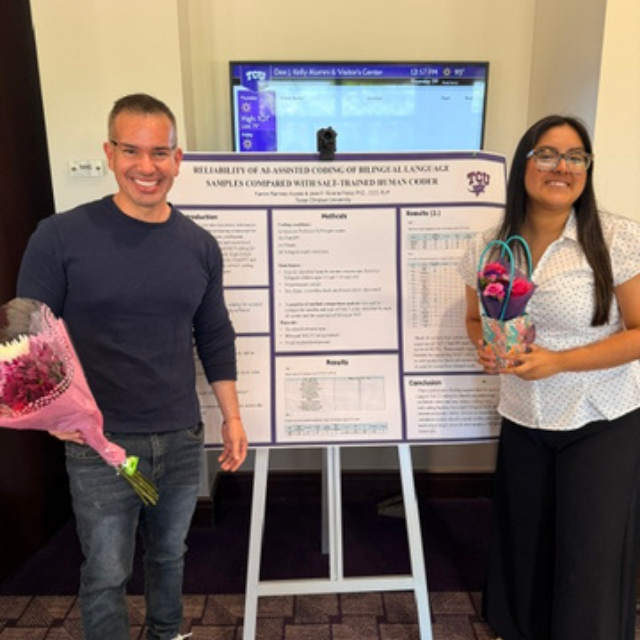
It’s July and a hot-even-for-Texas day. The TCU campus is quiet. Inside one room, though, Horned Frog undergraduate student researchers are presenting their work at the McNair Research Symposium.
Ramirez has just finished presenting her research on how artificial intelligence could reduce the time speech-language pathologists spend analyzing bilingual language samples.
When Rivera Pérez walks over, Acosta's face lights up. The nervousness that comes with presenting melts away for a moment. His help is a big reason why she is here.
“He is bilingual, and I knew I could learn so much from him,” said Acosta, who is a speech language pathology major with a minor in Spanish for health professions.
Rivera Pérez didn't just mentor Acosta through a summer research project. He helped a first-generation college student from Dallas see herself as a researcher.
"I would like to thank McNair and Dr. Rivera Pérez for dedicating the time to mentor me," she said. "It was an honor, and I plan to pay it forward."