TCU Lab to Test, Research Wearable Technology Across Industries
The clothes we wear do more than complete a look. They help control body temperature, manage sweat, protect the skin and support how people move, work and perform every day.
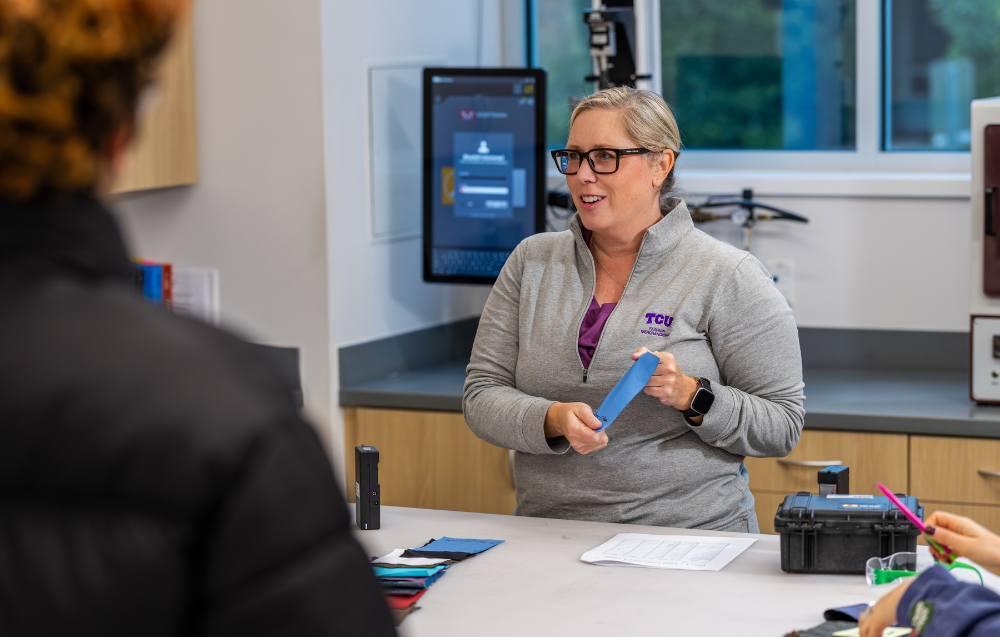
This fall, Texas Christian University’s Department of Fashion Merchandising launched the Athlete Equipment and Materials Design Lab, a new research and testing space focused on the products people depend on in extreme and demanding environments. Reaching far beyond the College of Fine Arts, the facility will support projects connected to athlete performance, rehabilitation, wearable health technologies, protective equipment and NASA-inspired soft goods research. Future work may also include recovery products, wound care materials, adaptive equipment and smart integrated gear for military personnel, first responders and industrial workers.
“We didn't build an academic research lab,” said Charles Freeman, professor and chair of fashion merchandising and director of research and creative scholarship in the College of Fine Arts. “We built an industry lab. We want students to walk into their first job and recognize the equipment because they've already used it here.”
The work has broad interdisciplinary applications. From athletes training in Texas heat to first responders in protective uniforms, military personnel in extreme conditions and astronauts preparing for space environments, the lab will help answer a practical question: how can the materials closest to the body help people perform better and stay safer?
“People often think of fashion as what they see in stores,” Freeman said. “But clothing does much more than that. It creates the environment around the body. How a garment handles heat sweat, movement and protection affects comfort, recovery, performance and safety.”
Beyond the Runway
Designed as part of TCU's continued investment in research and innovation, the lab
brings industry-level testing capabilities to campus and gives students, faculty and
partners a place to study how apparel, equipment and wearable materials perform in
real conditions.
Inside the lab, researchers will test how materials manage sweat, heat, movement, friction, pressure and exposure to water. The goal is to better understand how the products people wear can support the body in everyday life and in high-stress/high-demand environments. The university recently announced a new certificate and research partnership focusing on textiles and soft-goods engineering.
“How we interact with our clothing throughout the day — whether we're sitting on the couch watching TV, saving lives or traveling to space — matters because clothing helps protect the human body,” Freeman said. “That's really the science of what we do, and it broadens people's perspective of what fashion truly is.”
Built for Collaboration
The lab was designed as a shared space for researchers, students and industry partners
working on problems that connect the body, materials, movement and performance. It reflects
TCU’s continued investment in interdisciplinary research and gives faculty across
campus a new way to test the products and materials used in sports, health, work and
extreme environments.
The facility is already supporting projects with the Roach Institute for Athlete Engineering, which was made possible by a $10 million gift from the Roach Foundation of Fort Worth.
“At the Roach Institute, we’re interested in the entire ecosystem that influences human performance, and what someone is wearing is a major part of that,” said Jim Weinstein, director of the Roach Institute. “This lab gives us the ability to connect what we measure in the human body, movement, heat strain, fatigue and performance, with what is happening in the materials and equipment closest to it. That opens up an entirely new level of research for athletes, first responders, military personnel and others performing in demanding environments.”
Reuben Burch, vice provost for research, said that building a good research enterprise is like establishing departments in an organization. The new lab complements the work at the Roach Institute.
“We brought a new capability to Texas that wasn’t here before, and now it’s at TCU. So, we can expand beyond human performance and into the equipment and materials that all athlete personas will wear. This is the kind of research, invention and creation that people can continue to expect from TCU.”
The new lab is also working with TCU’s engineering, physics and kinesiology programs.
“I’ve been pleasantly surprised at the level of collaboration I've experienced since coming to TCU, said Graci Finco, assistant professor of kinesiology in the Harris College of Nursing & Health Sciences. “Our Limb Loss & Difference Lab has already begun several collaborations with both Charles and the Roach Institute to improve care and performance for people with limb loss and limb difference. I’m excited for what we are building together at TCU with other academic and industry partners.”
Research that Starts with Students
Faculty also anticipate the lab will play a central role in TCU’s new Ph.D. program in advanced soft goods and textile systems launching in 2027 by giving doctoral students access to applied research, product testing and industry-facing projects. It will also expand opportunities for undergraduate research, giving students the chance to work alongside faculty with real-world applications. Students will use the same tools found in industry while contributing to work connected to athlete performance, health, safety, product development and wearable technology.
For Freeman, the investment represents more than a new facility. It reflects the growing role of the College of Fine Arts in TCU’s research mission and the value of giving students access to applied research early in their academic careers.
“Investments like this demonstrate TCU’s commitment to becoming a leading R1 institution,” Freeman said. “Most importantly, they give our students the opportunity to ask big questions, solve real problems and take their ideas all the way to the finish line.”