Mathematics
You’ll master the language and methods of mathematics to solve problems in a variety of disciplines, opening up a wide range of opportunities after graduation.
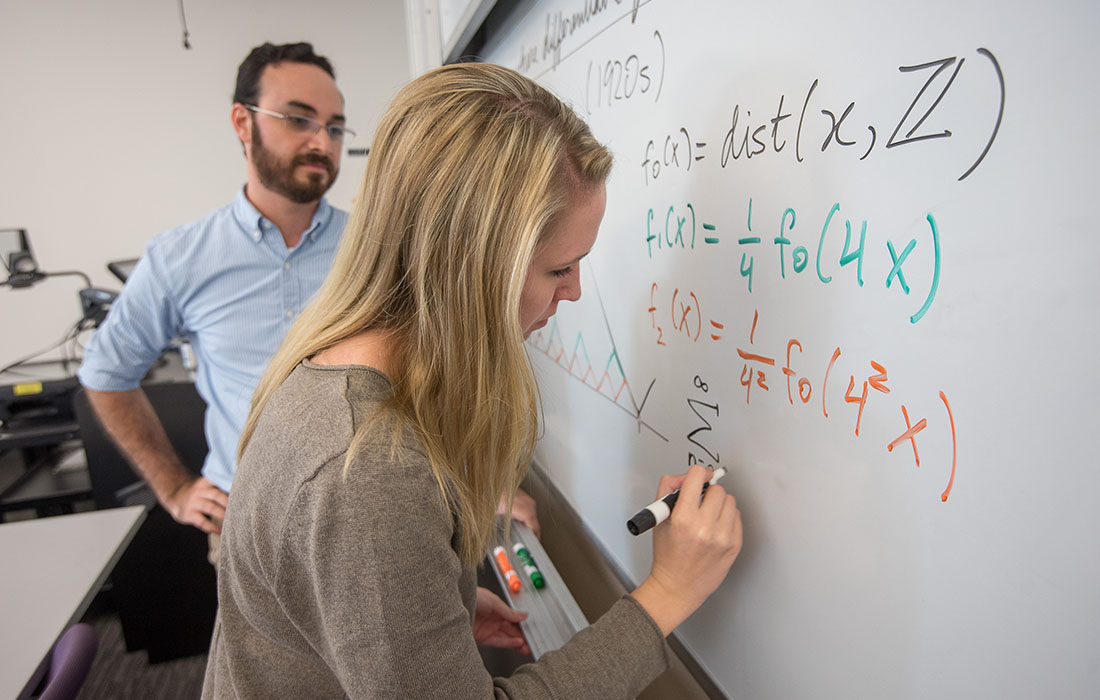
Mathematics is the language and “queen” of the sciences, essential to advancing knowledge across every discipline.
The analytical skills developed while undertaking a math degree will equip students to pursue careers in almost any field, whether data science, finance, education, law, or medicine.
The Bachelor of Arts, our liberal arts degree, is ideal for students seeking careers in economics, business, education, or associated industries, and it pairs well as a double major.
The Bachelor of Science is a more demanding degree with an additional 18 hours of advanced mathematics. It is a great fit for students planning to pursue graduate school in mathematics or related fields or technical careers in industry, or for anyone seeking a more challenging mathematical experience.
The Department of Mathematics also houses TCU’s Actuarial Science program and sponsors the BS in Data Science jointly with the Department of Computer Science.
Contact
- mathematics@tcu.edu
817-257-7335
Programs Offered
Sample Courses
- Abstract Algebra
- Calculus
- Discrete Mathematics I and II
- Linear Regression and Time Series
- Predictive Modeling
- Real Analysis
- Statistics

Core Curriculum
Your success is at our Core. TCU’s Core Curriculum prepares you to live and work in today’s ever-evolving diverse and global society. It encourages you to be intellectually curious and ask big questions about the world and your place in it.
Special Admission Requirements
There are no special admissions requirements for this program.
Our Faculty
You’ll learn from outstanding and award-winning faculty with doctoral degrees from Berkeley, Chicago, Michigan, Princeton, Rice and other top-rated universities.
What Sets Us Apart
Teacher-Scholars — TCU’s teacher-scholar model means professors are both teachers and researchers — often with involvement of both undergraduate and graduate students. When your teachers are involved scholars themselves, everyone benefits.
Interdisciplinary Focus — At TCU, there’s a shared willingness by faculty to collaborate across disciplines in teaching and research. Our goal is for students to build on their new knowledge, making valuable connections between concepts and ideas from different areas of study. This motivates our students to be more creative in their lifelong learning and enhances the critical thinking skills needed for problem solving in today’s world.
Career Prospects
In a rapidly changing global economy, the outlook for mathematicians is among the
brightest of all areas of study. According to the Bureau of Labor Statistics, overall
employment in math occupations is projected to grow much faster than the average for
all occupations through at least 2034. As the analysis of “big data” rises in importance,
so does the demand for professionals with math degrees.
TCU math majors have gone on to jobs in every sector of the economy, including these
top employers who have hired our graduates:
- JPMorgan Chase
- ExxonMobil
- Microsoft
- AIG
- Cigna
- Teach for America
- Lockheed Martin
- Deloitte
In addition, our students have gone to graduate schools at some of the best universities in the country:
- Mathematics, Columbia University
- Statistics, Ohio State University
- Public Health/Biostatistics, Washington University
- Computational Genomics, UNLV
- Data Analytics, Indiana University
- Economics, University of Texas at Austin
- Law, University of Tulsa
Related Academic Programs
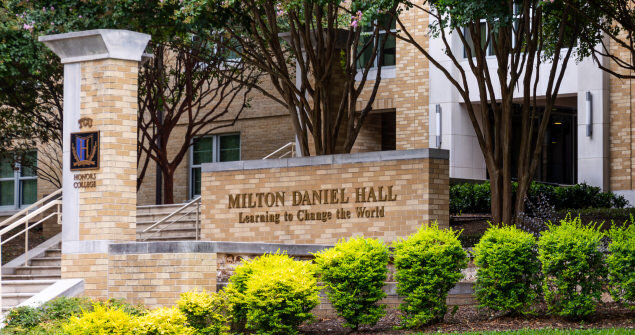
John V. Roach Honors College
Exceed your own expectations. Incoming and current undergraduate students of every major may apply. Unique classes are offered which connects students with a varied curriculum that is stimulating, supportive and cross-disciplinary.